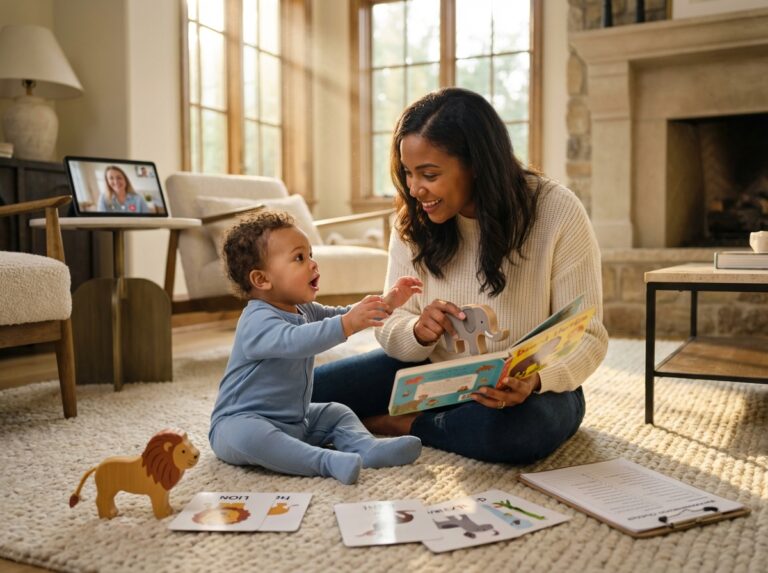
This practical guide walks parents through typical speech and language milestones from 12 to 36 months and shows how to support progress at home. Learn age-by-age expectations, red flags to watch for, evidence-based play ideas, tracking tools, and when to seek early intervention — all written for busy U.S. families seeking simple, expert-backed strategies.
Why speech milestones matter and how to use this guide
Watching a toddler start to communicate is one of the most significant parts of being a parent. It is a time of rapid change. You might notice your child going from simple babbles to full sentences in what feels like a few weeks. Tracking speech and language milestones between 12 and 36 months is not about being overbearing; it is about understanding the natural progression of your child’s development. This guide helps you see the big picture, allowing you to plan for your child’s needs with confidence. When you know what to look for, you can support their growth through everyday play.
Language is divided into two main categories. Receptive language refers to how your child understands words. It includes their ability to follow directions or point to a picture when you name it. Understanding usually happens before speaking; a child might know what a ball is long before they can say the word. Expressive language is how your child uses sounds or words to share their thoughts. It includes gestures like pointing or waving and the vocabulary they build over time. Both areas are vital. If a child understands well but speaks very little, the support they need differs from a child who struggles with both understanding and speaking.
Early speech sound development follows a predictable path. Toddlers start with easier “labial” sounds like m, b, p, and d because they use the lips. As they grow, they begin to master sounds that require more tongue control, like k, g, and t. By 24 months, a child’s speech is usually understood by a stranger about 50 percent of the time. By 36 months, that clarity increases to roughly 75 percent or more. It is normal for complex sounds like r or s to remain tricky until they are older. This guide helps you distinguish between normal sound errors and patterns that might need extra attention.
It is helpful to view milestones as ranges rather than exact cutoffs. Every child has a unique internal clock. Some toddlers focus on physical skills like climbing while others focus on talking. The Mayo Clinic notes that language development varies widely. Most milestones are based on what 75 percent or more of children can do by a specific age. If your child misses a milestone by a week, it is usually not a cause for alarm. However, looking at the overall trend of their growth is essential. Consistent progress is the goal.
Early detection is one of the most powerful tools a parent has. The toddler brain is incredibly flexible (neuroplasticity). If a delay is identified early, intervention can be very effective. In the United States, the Individuals with Disabilities Education Act (IDEA) Part C provides support for children under three. This program helps families get the resources they need during these formative years. Acting early leads to better outcomes for school readiness and reduces frustration for the child when they can finally express their needs.
Routine checks are a standard part of pediatric care in the U.S. Your pediatrician will perform developmental surveillance at every well-child visit, with specific milestone-focused checks at 12, 18, and 24 months. During the 18- and 24-month visits, doctors often use a tool called the M-CHAT-R to look at social communication and autism risk. They may also use the Ages and Stages Questionnaire (ASQ). These screenings are designed to catch potential delays before they become bigger challenges.
| Age Marker | Primary Focus of Check | Common Screening Tool |
|---|---|---|
| 12 Months | Early gestures and first words | Developmental Surveillance |
| 18 Months | Vocabulary and social engagement | M-CHAT-R and ASQ-3 |
| 24 Months | Two-word phrases and clarity | ASQ-3 Communication Domain |
| 30 Months | Complex sentences and play skills | Formal Developmental Screening |
This guide is organized to help you spot typical growth patterns while accounting for differences caused by temperament. A shy child might speak less in public but talk constantly at home. We also recognize that cultural variations are normal. Bilingualism is another common factor; learning two languages at once is a strength and does not cause speech delays. We will discuss the specifics of bilingual development in a later section.
Using this guide effectively means keeping a simple log of what you see. Note new words as they appear and pay attention to how your child follows instructions during bath time or meals. These real-world observations are more valuable than any single test, giving your pediatrician a clear window into your child’s daily life.
Age by age milestones from 12 to 36 months
Understanding the specific steps of language growth helps you support your child without unnecessary stress. These milestones represent what about 75 percent of children can do by a certain age. Every child follows their own path, but these markers provide a reliable map for the first three years of life.
12 Months
At one year, your child is transitioning from making sounds to using intentional words. Receptive language is strong; they should look when you call their name and understand simple words like “no” or “bye-bye.” You will notice them following a command if you use a gesture, such as holding out your hand and saying “give it to me.” Expressively, most 12-month-olds say “mama” and “dada” specifically for their parents. They might have one or two other words like “uh-oh” or “ball.” Socially, they use pointing to show you things or to ask for a snack. Their play is functional, meaning they use toys as intended, like rolling a car.
Parent: Where is the doggy?
Child: Points to the family pet and says “Dog!”
15 Months
By 15 months, vocabulary begins to expand beyond the immediate family. Children at this age typically understand around 50 words even if they only say a few. They can follow simple directions without you needing to point, such as “sit down” or “come here.” Expressively, you might hear three to five words used consistently. They use a mix of real words and jargon (babbling that mimics conversation). Socially, they will bring you a toy just to show it to you. Their play starts to include simple imitation, like pretending to talk on a phone.
Parent: Can you give me the cup?
Child: Hands the cup to the parent and smiles.
18 Months
This is a major turning point for communication. A typical 18-month-old uses between 20 and 50 words. Their receptive skills allow them to point to at least three body parts when asked. They can follow one-step directions like “put the book on the table.” You will see more joint attention, where they look at an object and then look back at you to make sure you see it too. Play becomes more purposeful, such as pretending to feed a stuffed animal. If a child has fewer than 10 words at this stage, it is a good idea to mention it to a pediatrician.
Parent: Show me your nose.
Child: Points to their nose and says “Nose.”
24 Months
By the second birthday, the “vocabulary spurt” is often in full swing. Most toddlers have at least 50 words and have started putting two words together. These combinations usually involve a noun and an action, like “mommy go” or “more juice.” Their receptive language allows them to follow two-step commands such as “get your shoes and put them by the door.” Speech clarity is a big focus here; a stranger should be able to understand about 50 percent of what the child says. In play, they start using one object to represent another, like using a block as a phone.
Child: Big truck!
Parent: Yes, that is a big red truck.
30 Months
At two and a half years, language becomes much more descriptive. Children start using action words like “running” or “eating.” They understand concepts like “big” and “small” or “on” and “under.” Their expressive vocabulary is often too large to count easily, and you will hear them using three-word phrases regularly. Socially, they begin to take more turns in a conversation. Their play is more complex, and they might act out a short sequence of events, like putting a doll to bed and then singing to it.
Child: Doggy is sleeping.
Parent: You are right, the doggy is taking a nap.
36 Months
By age three, your child is a true communicator. They use sentences with four or more words and start using pronouns like I, me, and you. They can tell you a simple story about their day. Their speech should be 75 percent to 100 percent intelligible to people who do not know them well. They understand most of what is said in daily routines. Play is now highly symbolic and social; they might play house with other children or create elaborate imaginary worlds.
Child: I want the blue car please.
Parent: Here is the blue car. Do you want the red one too?
| Age | Word Count | Intelligibility (to strangers) | Key Social Skill |
|---|---|---|---|
| 12 Months | 1 to 3 words | N/A | Pointing to show interest |
| 18 Months | 20 to 50 words | 25% | Joint attention |
| 24 Months | 50+ words | 50% | Two-word combinations |
| 36 Months | 200+ words | 75% to 100% | Short storytelling |
Variability is normal in these early years. Some children are quiet observers who understand everything but speak less, while others are very vocal early on. However, if you notice a loss of skills or if your child is not meeting the minimum markers for their age, seeking an evaluation is a proactive step. You can find more details on these stages through the Mayo Clinic resources.
How to track progress and use screening tools at home
Keeping a consistent record of how your child communicates is one of the most helpful things you can do. It moves the conversation with professionals from vague feelings to clear data. You do not need expensive equipment or a medical degree to do this well. A simple notebook or a dedicated note on your phone is enough to capture the small shifts that happen between 12 and 36 months.
Practical Home Tracking Methods
The Milestone Log
Write down new words as they happen. Include the date and the situation. It is helpful to note if the word was used spontaneously to ask for something or if the child was just repeating what they heard. For toddlers nearing 24 months, start recording two-word combinations. Examples like “my toy” or “mama go” are major milestones. You should also track comprehension. Note when your child follows a direction like “put the block in the box” without you using hand gestures. This shows their receptive language is growing even if they are not talking much yet.
Video Documentation
Short video clips are a gold mine for speech-language pathologists. Aim to record 30 to 90 seconds of your child playing or looking at a book once a month. These clips capture speech clarity, gestures, and how the child takes turns in a conversation. If you have a specific concern, try to catch that behavior on camera. Having a visual record from 18 months compared to 24 months makes progress much easier to see.
Standardized Screening Tools for Parents
In the U.S., several free or low-cost tools help parents benchmark development. These are often used in pediatric offices, but you can use them at home to prepare for appointments.
Ages and Stages Questionnaires (ASQ)
The ASQ is a highly regarded screening system. It uses parent-completed forms to check communication, motor skills, and social-emotional growth. The communication section asks specific questions about whether a child follows directions or uses certain types of words. If a score falls below a specific cutoff, it is a clear signal to seek a professional evaluation.
MacArthur-Bates Communicative Development Inventories (CDI)
The CDI is a vocabulary checklist widely used in research and clinical settings. There are different forms based on age: the “Words and Gestures” form is for younger toddlers (8-18 months), while “Words and Sentences” is for those over 16-30 months. It helps you quantify exactly how many words your child says and understands. Language development milestones often reference these vocabulary counts as key indicators of growth.
The Importance of Hearing Checks
Before a speech delay is diagnosed, you must rule out hearing loss. This is a standard first step. Even if your child seems to hear loud noises, they might have fluid in their ears that muffles speech sounds. This makes it hard for them to learn how to form words correctly. A formal audiology exam is necessary to ensure the “input” is clear before focusing on the “output” of speech.
Preparing for the Conversation
When you meet with a pediatrician or an Early Intervention team, come prepared with your data. This makes the triage process much faster. Bring your word list, a few examples of followed directions, and your monthly video clips. In the U.S., the IDEA Part C program provides services for toddlers with delays. You can often refer your child yourself without waiting for a doctor to do it. CDC Milestone Moments provides a structured way to organize these observations before your appointment.
| Tool Name | What It Tracks | Best Age Range |
|---|---|---|
| ASQ-3 | General development and communication | 1 month to 5 years |
| MacArthur-Bates CDI | Vocabulary size and grammar use | 8 to 30+ months |
| M-CHAT-R | Social communication and autism risk | 16 to 30 months |
| Home Video Log | Speech clarity and social interaction | All ages |
Tracking Frequency
You do not need to take notes every day. Monthly summaries are usually enough to see the big picture. If your child is in a “vocabulary spurt” phase, you might find yourself writing down new words every week. The goal is to have a functional history of their growth to share with experts if the need arises.
Evidence based home strategies to boost speech and language
Building a language-rich environment at home does not require expensive tools or rigid lessons. Research shows that the quality of daily interactions predicts language outcomes better than the total number of words a child hears. Effective support happens during bath time, meals, and floor play. These moments allow for natural communication without the pressure of a performance.
Following the Lead and Parallel Talk
This technique involves acting like a sports commentator for your child. Instead of telling them what to do, you describe what they are seeing and doing. If a 14-month-old is banging a spoon, you say, You are banging the spoon. Loud noise! For a 30-month-old playing with a doll, you might say, You are putting the doll to bed. She is very sleepy. This reduces the pressure on the child to answer questions and provides a direct link between their actions and the words that describe them. Aim for 5 minutes of focused parallel talk during three different play sessions each day.
Expansion and Recasting
When your child speaks, you repeat their words and add one or two more. If an 18-month-old says Car, you expand it to Blue car or Fast car. For a 36-month-old who says Doggy run, you recast it into a complete sentence like Yes, the doggy is running in the grass. This provides a model for the next level of grammar without explicitly correcting them. It keeps the conversation flowing and builds confidence. Use this naturally throughout the day whenever your child initiates speech.
Modeling Short Phrases
Keep your own sentences just one step ahead of your child. If they are using single words, speak in two-word phrases. If they use two words, move to three. This makes your speech easier for them to process and imitate. For a younger toddler, use phrases like More juice or Big bubbles. For an older toddler, try Put the block on top. This strategy works best when integrated into routines like dressing or cleaning up toys.
Prompting Choices Instead of Open Questions
Open questions like What do you want to wear? can be overwhelming for a toddler. Offering a binary choice provides the vocabulary they need to respond. Hold up two items and ask, Do you want the red shirt or the blue shirt? This gives them a script to follow. For a 12-month-old, they might point to choose. By 24 months, they will likely attempt to say the word. This reduces frustration and encourages verbal participation during transitions.
Dialogic Reading and Shared Book Routines
Reading should be a conversation rather than a lecture. With a 15-month-old, focus on labeling pictures and letting them turn the pages. With a 30-month-old, use the PEER method: Point to a picture, ask them what it is, evaluate their response, and expand on it. If they point to a bear, you say, That is a big brown bear. What is the bear doing? Shared reading for 15 minutes a day is one of the most effective ways to boost vocabulary. Sturdy board books are great for younger toddlers, while picture books with repetitive lines work well for older ones.
Singing and Nursery Rhymes
Music helps children hear the rhythm and individual sounds of language. Use songs with gestures like Itsy Bitsy Spider or Wheels on the Bus. Pause before the last word of a familiar line to see if your child fills it in. This encourages anticipation and vocalization. For older toddlers, you can make up silly rhymes about their toys to build phonological awareness. Singing during diaper changes or car rides is an easy way to fit this into a busy schedule.
Target-Word Routines
Pick three functional words to focus on each week during specific routines. During bath time, you might target Splash, Soap, and Wet. Use these words repeatedly while the child is experiencing the action. This contextual learning helps the brain map the word to its meaning faster. Mealtime is another perfect opportunity for words like Eat, More, or All gone. Consistency is more important than the variety of words used in these moments.
Play-Based Vocabulary Boosters
Use toys to model actions and adjectives. While playing with a toy kitchen, name the items and describe what is happening. Use words like Hot, Cold, Stir, or Yummy. For younger toddlers, focus on simple nouns. For older toddlers, add descriptive words and action verbs. Blocks, play dough, and toy animals are excellent for this. Try to spend 20 minutes a day in child-led play where you focus on these boosters.
Turn-Taking Games
Communication is a back-and-forth exchange. Games like rolling a ball, hide-and-seek, or simple imitation games teach the foundational rules of conversation. For a 12-month-old, this might be as simple as mimicking their babbles. For a 36-month-old, it could involve a pretend tea party where you wait for them to pour before you drink. These games build the social-pragmatic skills necessary for later language development.
Phonological Play and Visual Supports
Encourage early speech sounds by playing with noises. Make animal sounds or car noises like Vroom and Beep. These are often easier for toddlers to produce than actual words. Use gestures and simple signs alongside your speech to provide a visual bridge. Research from the Mayo Clinic suggests that using gestures can actually help children transition to verbal speech more quickly. Pointing and waving are key milestones that support communication before words are fully formed.
| Age Group | Practice Frequency | Recommended Toys/Activities |
|---|---|---|
| 12–18 Months | 15–30 minutes daily | Stacking cups, board books, balls, cause-and-effect toys |
| 24–36 Months | 20–45 minutes daily | Toy kitchens, dolls, simple puzzles, repetitive picture books |
Integrating these strategies into your existing routine is more sustainable than setting aside time for drills. The goal is to make communication fun and functional. If you notice your child is not meeting the milestones discussed in the previous chapter despite these efforts, it may be time to look at professional evaluations.
When to seek help and what evaluations look like
Watching a child grow is a mix of joy and quiet observation. Parents often wonder if their toddler is on the right track with speech. While every child follows a unique path, certain markers help identify when extra support is needed. Recognizing these signs early allows for faster progress through professional guidance.
Speech and Language Red Flags
Red flags are specific behaviors or missing milestones that suggest a delay. If a child does not babble or use gestures like pointing by 12 months, it is time to talk to a professional. By 15 months, most children use several single words. A child who has no words by 18 months or fewer than 50 words by 24 months should be evaluated. Another major sign is the inability to combine two words into a phrase like “more milk” by age two. A critical red flag is the loss of skills. If a toddler stops using words or gestures they once had, seek an evaluation immediately. This regression can happen at any age and requires professional attention. Limited social interaction or a lack of interest in play with others also warrants a checkup.
| Age | Speech and Language Red Flags |
|---|---|
| 12 Months | No babbling, no pointing, or no use of gestures |
| 15 Months | No single words used to name objects or people |
| 18 Months | Fewer than 10 to 20 words in total |
| 24 Months | Fewer than 50 words or no two-word combinations |
| 36 Months | Speech that is very difficult for strangers to understand |
| Any Age | Loss of previously acquired speech or social skills |
The Evaluation Pathway in the United States
The process usually begins with the pediatrician. During well-child visits at 18 and 24-30 months, doctors use screening tools to check development. If there is a concern, the first step is often a hearing test with an audiologist. Even a mild hearing loss from fluid in the ear can slow down language development. Ruling out physical hearing issues is a standard part of the language development assessment.
Early Intervention and School Districts
For children under three years old, the next step is a referral to Early Intervention. This is a federally funded program under IDEA Part C. It provides evaluations and services at little or no cost to families. If the child is three or older, the local school district handles the evaluation and support (Part B). Some families choose to see a private speech-language pathologist or a developmental pediatrician for a more specialized look. A multidisciplinary approach might include an Ear, Nose, and Throat (ENT) specialist if chronic ear infections are a factor.
What an SLP Evaluation Examines
An evaluation with a speech-language pathologist (SLP) is a thorough look at how a child communicates. The therapist examines receptive language (understanding) and expressive language (speaking). Articulation is checked to see if speech sounds are clear for the child’s age. Pragmatics and play are part of the assessment; the therapist watches how the child uses language to interact and how they use toys to represent real-life actions. This helps determine if the child’s communication skills match their cognitive development.
How Parents Can Prepare
Parents play a vital role in this assessment. It is helpful to bring a list of words the child uses and a log of milestones. Short video clips of the child playing or talking at home provide a clear picture of their natural skills. These videos are often more accurate than how a child acts in a new clinic setting. Bringing results from previous hearing tests or medical records will help the therapist understand the full history. The Milestone Moments booklet from the CDC is a great resource for tracking these behaviors before the appointment.
Intervention and Therapy Options
Intervention often involves weekly therapy sessions. Many programs now offer telepractice, which has proven effective for early language goals. Therapy usually focuses on parent coaching. The therapist teaches the family how to use strategies during daily routines. Consistent practice at home leads to the best outcomes for the child. The frequency of therapy depends on the child’s specific needs and the goals set by the family and the therapist.
Supporting bilingual and multilingual toddlers
Raising a child with two or more languages is a gift that lasts a lifetime. Many parents worry that hearing multiple languages will confuse their toddler or cause a speech delay. Current research is very clear on this point: Bilingualism does not cause language delays. A toddler learning two languages follows the same developmental timeline as a child learning one. They might start speaking at the same age and hit the same milestones for combining words.
If a bilingual child has a speech delay, it is because of an underlying issue, not the languages they hear at home. Families should never feel pressured to switch to speaking only English. This can actually hurt the child’s language development by limiting the rich, complex input they get from their parents. Stick to the language you are most comfortable with to ensure your child hears natural grammar and a wide range of words.
Understanding Concept Vocabulary
Measuring Progress
When you track progress, look at the total number of words across all languages. This is called “concept vocabulary.” If your child says agua in Spanish and apple in English, they have two words. If they say milk and leche, they have two words for one concept. Both count toward their total word count. At 24 months, we look for about 50 words total, regardless of which language those words come from. Research recommends tracking combined vocabulary when screening bilingual toddlers to avoid under-identifying their true abilities.
| Milestone Age | Bilingual Expectation (Combined Languages) |
|---|---|
| 12 Months | Responds to name. Uses a few words or gestures. |
| 18 Months | Uses 20 to 50 words. Follows simple commands. |
| 24 Months | Uses 50 plus words. Begins combining two words. |
| 36 Months | Uses multi-word sentences. Majority of speech is intelligible. |
Practical Strategies for Multilingual Homes
Consistency and Rich Input
Provide rich input in both languages. Some families use the “one-person-one-language” approach, while others use the minority language at home and English at daycare. Both methods work well. The key is consistency and variety. Use separate books for each language and incorporate them into distinct routines.
Home Activities
Use daily routines to boost vocabulary. During bath time, name the body parts in both languages. Read books in your native language and talk about the pictures naturally without translating everything. Play games like I Spy using words from both languages. This helps the child see that both ways of speaking are valuable. Label objects consistently in each language and encourage relatives to speak in their native language to provide rich input.
Navigating Evaluations and Fair Assessment
Communicating with Providers
If you have concerns, talk to your pediatrician. Be specific. Mention if your child understands more in one language than the other. This is common; a child might have a stronger receptive vocabulary in the language spoken at home and a stronger expressive vocabulary in the language used at school. Tell your provider exactly which languages your child hears and who speaks them to ensure a fair assessment.
Your Rights in the U.S. System
Ask for a bilingual speech-language pathologist (SLP). If one is not available, you have the right to an interpreter. An evaluation must look at both languages to be accurate. A child might seem delayed if only tested in English but show age-appropriate skills when their home language is included. Clinicians should use trained interpreters and assess both receptive and expressive skills in each language to avoid misclassifying typical bilingual development as a disorder.
Guidance for Immigrant Families
Culturally Responsive Approaches
Many immigrant families feel pressure to drop their native tongue, worrying it will hold their child back in school. This is not true. A strong foundation in a first language helps a child learn a second one and keeps them connected to their family and culture. U.S. clinicians are advised to consider cultural context; some cultures emphasize nonverbal communication or use less infant-directed speech. These differences are not delays. According to the Mayo Clinic, language development is a complex process influenced by many factors. Bilingualism is a strength, not a hurdle.
Frequently Asked Questions
Parents often have a lot of questions when they start tracking speech milestones. It is normal to feel a bit of pressure as you watch your child grow. This list covers the most common concerns families face between the ages of 12 and 36 months. The answers are based on current clinical standards and the latest developmental research.
How many words should my child say at 18 months?
Most toddlers at this age use between 20 and 50 words. The CDC Milestone Moments guide suggests that by 18 months, a child should be able to say several single words. If your child has fewer than 10 to 20 words, you should bring this up with your pediatrician. Some children experience a vocabulary spurt during this window, while others take a bit more time. The key is to look for steady progress in how they use words to get what they need.
Is it serious if my 12-month-old is not babbling?
Yes, a lack of babbling at 12 months is a significant red flag. Babbling is the foundation for spoken language. It shows that a child is experimenting with sounds and understands the back-and-forth nature of communication. If your child is not making consonant sounds like “ba,” “da,” or “ma,” you should act quickly. This can sometimes be a sign of hearing loss or a developmental delay. Your first step should be a formal hearing test to rule out any physical barriers to sound.
Will using baby sign language delay my child’s speech?
No, research shows that signs do not slow down talking. In fact, using gestures or simple signs can reduce frustration for toddlers who cannot yet say the words they want. It gives them a way to communicate while their speech muscles are still developing. The best approach is to always say the word clearly while you make the sign. This pairs the sound with the movement and helps the child eventually transition to using only the spoken word.
Does screen time affect how a toddler learns to talk?
Passive screen time can negatively impact language development if it replaces human interaction. Toddlers learn best through conversational turns with real people. The American Academy of Pediatrics recommends avoiding screens for children under 18 months, except for video chatting with family. For toddlers between 18 and 24 months, any screen use should involve a caregiver. You should sit with your child and talk about what is happening on the screen to make it an active learning experience.
When is the right time to get a hearing test?
You should request a hearing test the moment you have a concern about speech. Even if your child passed their newborn screening, they can develop issues later. Fluid in the middle ear is very common in toddlers and can make sounds seem muffled. This makes it much harder for them to learn how to produce clear speech. A pediatric audiologist can perform objective tests to ensure your child is hearing all the frequencies needed for language.
Can learning two languages cause a speech delay?
Bilingualism does not cause language delays. A child learning two languages might have a smaller vocabulary in one specific language compared to a monolingual peer, but their “concept vocabulary” (total words known across both languages) should meet standard milestones. If you have concerns, ensure the evaluation looks at both languages to get an accurate picture of their skills.
When does a child’s pronunciation become a problem?
Speech clarity improves gradually. By 24 months, a child should be understood by strangers about 50 percent of the time. According to NIH research on articulation, speech rates and clarity increase significantly as children approach age three. By 36 months, most of what a child says should be intelligible to unfamiliar listeners. If your child is very difficult to understand at age three, it may be time to see a speech-language pathologist to check their articulation.
How long does it take for speech therapy to show results?
Progress depends on the child and the consistency of home practice. You might see small, measurable gains within 6 to 12 weeks of starting a program. This could include a few new words or more frequent attempts to communicate. Long-term functional changes usually take several months. Speech therapy for toddlers often focuses on coaching parents to use strategies during daily routines. The more you use these techniques at home, the faster your child is likely to progress.
What should I do if my pediatrician says to wait and see?
You do not have to wait if you feel something is wrong. Parents are often the first to notice a delay. In the U.S., you can contact your state’s Early Intervention program directly. This is a federal program under IDEA Part C that provides evaluations for children under age three. You do not need a doctor’s referral to start this process. Early support is much more effective than waiting until a child starts school to address a delay.
How can I support a toddler who is a shy talker?
Focus on low-pressure interactions. Avoid asking “What is this?” or telling them to “Say apple.” This can make a shy child shut down. Instead, use parallel talk by describing what they are doing. If they are playing with a truck, you can say, “You have the big blue truck. The truck goes fast.” Offering choices is also helpful. Asking “Do you want the milk or the juice?” gives them a reason to use a word without feeling like they are being tested.
What are the most common screening tools used in the U.S.?
Doctors often use standardized questionnaires to check development. The most common include the Ages and Stages Questionnaire (ASQ-3), which tracks general development from 1 month to 5 years; the M-CHAT-R, which screens for social communication and autism risk between 16 and 30 months; and the CDI Vocabulary Checklist, which measures specific word counts and gestures based on parent reports for children 8 to 30 months.
What is the first step if I am worried about milestones?
Start by keeping a simple log of the words and gestures your child uses. Note down what they understand as well. Bring this log and a short video of your child playing to your next appointment. This gives the professional a clear view of your child’s skills in a natural setting. You can also search for your state’s Early Intervention office online to request a free developmental screening.
Key takeaways and next steps for parents
Supporting a child through the early years of language development is a journey that requires patience. You are the most important person in this process. Your daily interactions shape how your toddler understands the world. By the end of the first three years, most children move from simple babbles to complex sentences. This progress happens in stages. You can find a detailed breakdown of these stages in the Language development: Speech milestones for babies – Mayo Clinic guide. Understanding these markers helps you stay informed without feeling overwhelmed.
The Trajectory of Growth
Remember the general path: 12-month-olds focus on gestures and first words; 18-month-olds expand their vocabulary and follow simple directions; 24-month-olds combine words into phrases; and 36-month-olds speak in sentences that strangers can mostly understand. Keeping this progression in mind helps you identify where your child is on their unique timeline.
Acting on Red Flags
Trust your instincts. Research shows that parent concerns are often accurate predictors of a delay. If you notice specific warning signs—such as no babbling by 12 months, no single words by 15 months, or a lack of two-word combinations by 24 months—contact a professional. The most urgent red flag is a loss of skills; if your child stops using words or gestures they once had, seek an evaluation immediately.
Simple Daily Routines to Try Now
You do not need expensive toys to boost language. Use parallel talk during the day by describing what your child is doing as they do it. It is like being a narrator for their life. Another technique is expansion: if your child says “dog,” you say “yes, a big dog.” This models how to build sentences without pressure. Use dialogic reading when you look at books; instead of just reading the text, ask simple questions, point to pictures, and wait for them to respond. These short bursts of interaction are more effective than long sessions of forced practice.
How to Track Progress Effectively
Keeping a record helps you see small wins that are easy to miss. Start a video diary on your phone; record a 60-second clip once a month of your child playing or talking. These clips provide excellent evidence for speech therapists. You should also keep a word log, writing down new words as they appear and noting if they used the word on their own or just repeated you. Tracking comprehension is just as vital; note when they follow a new command like “get your shoes.” This data makes your doctor visits much more productive.
Clear Thresholds for Professional Contact
The first step is always a hearing check. Even a mild hearing loss can slow down speech. Ask your pediatrician for a referral to an audiologist. In the United States, you can also contact Early Intervention services directly without a doctor’s referral. These services fall under IDEA Part C and provide evaluations for children under three years old. You can find your local office by searching for your state name and the phrase “early intervention part c.” Most states are required to complete an evaluation within 45 days of your call. If your child is over three, contact your local school district for an evaluation.
The Power of Early Support
Acting early is the best gift you can give your child. The brain is very flexible during these first 36 months. Early support can prevent future frustrations in school. It is not about fixing something that is broken; it is about giving your child the tools to express their thoughts. Every time you respond to their babbles or expand on their words, you are building their brain. You can find more details on what to expect in the Milestone Moments Booklet 2021 – CDC. Stay consistent. Keep the interactions playful. Your engagement is the most powerful tool for their development.
References
- Language development: Speech milestones for babies – Mayo Clinic — By the end of six months, your child might: Make gurgling sounds when playing. Babble and make a range of sounds. Use the voice to show likes and dislikes. Move …
- Speech Development Between 30 and 119 Months in Typical … – NIH — The median rate (50th percentile) increased from 2.7 sps at 36 months to 3.3 sps at 96 months. The 5th percentile increased from 2.3 to 3.1 sps over the same …
- A Guide to Language Development Milestones – Brightwheel — Other language development skills in this age group include responding to rattle sounds, making noise and smiling when spoken to, and vocalizing …
- Speech and Communication Development – Birth to 3 Years — At the age of 6-12 months your child should begin responding to their name, understand the meaning of “no,” and use gestures such as lifting …
- 11.9: Charting language growth in infants and toddlers — By twelve months of age the median number of words an infant understood was around 20; however, just a few months later (fifteen months) the …
- Measures of Early Social Communication and Vocabulary … – NIH — Measures of social communication between 18–21 months added important information to predicting language outcomes at 2 and 3 years, above and beyond parent- …
- How Many Words Should Kids Say? And When? – Parent Data — This data says that the average child — that's the 50th percentile line — at 16 months has about 36 words or gestures. A child at the 10th …
- [PDF] Milestone Moments Booklet 2021 – CDC — These developmental milestones show what most children (75% or more) can do by each age. Subject matter experts selected these milestones based on available …
Legal Disclaimers & Brand Notices
The content provided in this article is for informational purposes only and does not constitute professional medical advice, diagnosis, or treatment. Always seek the advice of your physician, speech-language pathologist, or other qualified health provider with any questions you may have regarding a medical condition or developmental milestones. Never disregard professional medical advice or delay in seeking it because of something you have read in this guide.
All product names, logos, and brands are property of their respective owners. All company, product, and service names used in this article are for identification purposes only. Use of these names, trademarks, and brands does not imply endorsement.