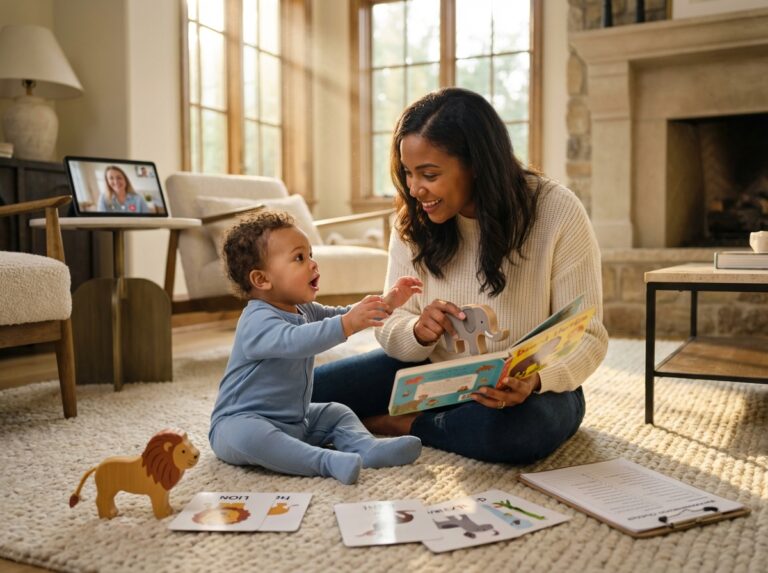
Understanding how much a toddler should be understood by age 3 helps parents spot typical development and early concerns. This article explains speech intelligibility benchmarks, common error patterns, practical home strategies from speech and language experts, and answers to parents’ top questions so you can support your child’s language growth with play-based, everyday routines.
Speech intelligibility benchmarks and what they mean
One of the most common questions parents ask is, “Should I be able to understand everything my toddler says?” The short answer is no. The journey to clear speech is a gradual one, and it’s completely normal for a toddler’s words to be a work in progress. Speech-language pathologists use the term speech intelligibility to measure how much of a child’s speech can be understood. It’s a key indicator of whether their speech sound development is on track.
A critical piece of this puzzle is understanding the difference between how much you understand versus how much a stranger might understand. Parents and close caregivers are experts at decoding their child’s unique speech. You have context, you know their routines, and you’re familiar with their specific sound substitutions. An unfamiliar listener, like a neighbor or a cashier at the store, doesn’t have that advantage. That’s why professional benchmarks for intelligibility are almost always based on what an unfamiliar listener can understand.
While every child develops at their own pace, there are widely accepted guidelines that help parents and pediatricians gauge progress. These benchmarks have been a clinical standard for years, though recent research using different methods has provided a more detailed, and sometimes more conservative, picture.
- By 12-18 months
At this stage, your child is likely using a mix of babbling, jargon (speech-like sounds with adult intonation), gestures, and a handful of single words. A parent might understand about 25% of what their 18-month-old says, but an unfamiliar listener would understand very little. - By 24 months (2 years)
This is a major milestone. The classic rule of thumb is that a 2-year-old should be about 50% intelligible to an unfamiliar listener. Their vocabulary is growing rapidly, and they are starting to combine two words together, like “more juice” or “daddy go.” - By 36 months (3 years)
By their third birthday, a child’s speech should be roughly 75% intelligible to an unfamiliar listener. They are now using three- and four-word sentences and can hold simple conversations. While their speech is much clearer, it’s still not perfect.
It’s worth noting that some newer studies, like a key paper by Hustad and colleagues in 2021, found lower intelligibility percentages when unfamiliar listeners heard only audio recordings without any visual or social context. This highlights that the old 50% by age 2 and 75% by age 3 rules are practical clinical guides, not absolute laws. The important thing is to see steady progress toward clearer speech.
This gradual increase in clarity is tied directly to a toddler’s growing ability to produce different speech sounds. By age 3, most children have mastered the early-developing sounds, including p, b, m, n, h, w, t, d, k, and g. However, many later-developing sounds are still tricky. It is perfectly normal for a 3-year-old to struggle with sounds like r, l, s, z, ch, sh, and th. These sounds often don’t become consistent until ages 5, 6, or even 7.
Toddlers also use predictable, developmental shortcuts to make talking easier. These patterns, called phonological processes, are a normal part of learning to speak. Common ones you might hear include:
- Final Consonant Deletion
Leaving the last sound off a word. For example, saying “cah” for “cat” or “bu” for “bus.” This pattern usually fades around age 3. - Cluster Reduction
Simplifying a consonant blend by dropping one of the sounds. For example, saying “poon” for “spoon” or “top” for “stop.” This can persist until age 4 or 5. - Fronting
Substituting sounds made in the back of the mouth (like k, g) with sounds made in the front (like t, d). For example, saying “tar” for “car” or “do” for “go.” This typically resolves by age 3.5 to 4. - Gliding
Replacing the r and l sounds with w or y. For example, saying “wabbit” for “rabbit” or “yeyo” for “yellow.” This is very common and can last until age 5 or later.
Several other factors can influence how clear your child’s speech is. Hearing is foundational; even temporary hearing loss from frequent ear infections can impact speech development. Bilingualism can also play a role, as children navigate two different sound systems, but it does not cause a disorder. A child’s temperament and the amount of language they hear at home also contribute to their progress.
While variability is normal, certain signs may indicate that it’s time to seek a professional opinion from a pediatrician or a speech-language pathologist (SLP). Here is a quick reference guide to help you track your child’s progress.
Quick Intelligibility Guide & Red Flags
- By 18 Months
Expectation: A growing vocabulary of single words.
Red Flag: Saying few or no words.- By 24 Months
Expectation: About 50% intelligible to strangers; using two-word phrases.
Red Flag: Less than 50% intelligible; not yet combining words.- By 36 Months
Expectation: About 75% or more intelligible to strangers; using multi-word sentences.
Red Flag: Less than 75% intelligible; speech is very difficult for family to understand.- At Any Age
Red Flags: A sudden loss of previously used words (regression), unusual voice quality (hoarse or nasal), or significant difficulty with feeding and swallowing.
If you notice any of these red flags, the first step is often a hearing check to rule out any underlying issues. From there, a speech and language evaluation can determine if your child needs extra support. Trust your instincts. You know your child best, and early support can make a world of difference. For more details on developmental milestones, you can explore resources like this guide to speech milestones.
Practical home strategies to boost speech and language growth
Knowing the milestones is one thing; actively helping your child meet them is another. The good news is that you don’t need special tools or a rigid schedule. The most powerful language learning happens right within your daily life, turning ordinary moments into opportunities for connection and growth.
Embedding Language into Daily Routines
Your day is already full of routines that are perfect for boosting speech. The key is to be intentional with your words. Here are four high-impact strategies to use.
- Parallel Talk
Think of yourself as a sportscaster for your toddler’s life. Narrate what they are doing, seeing, or touching. During bath time, you might say, “You’re splashing! Splash, splash, splash. Now you have the blue boat. The boat is floating.” You aren’t asking questions; you’re simply providing a rich stream of language connected to their actions. - Language Modeling
This is about giving your child the words for things. When they point to their cup, model the word clearly, “Cup. That’s your cup.” Keep it simple and repeat it. The goal is to provide a clear, correct model without pressure. - Expansions
When your toddler uses a word or two, build on it. If they say, “Doggie,” you can expand it by saying, “Yes, a big doggie! The big doggie is running.” This shows them how to build bigger sentences and adds new vocabulary like “big” and “running.” - Recasts
This is a gentle way to correct grammar. If your child says, “Her go home,” you can recast it by saying, “Yes, she is going home.” You’re not saying, “That’s wrong.” You’re simply repeating their idea back to them with the correct structure.
12 Play Ideas and Vocabulary Boosters
Play is a toddler’s work, and it’s the best place to practice new skills.
Toy Play
- Car Race Commentary
Use cars to model action words (go, stop, fast, crash) and prepositions (up the ramp, under the bridge). - Animal Parade
Line up toy animals and practice their sounds and names. Expand by describing them, “The big elephant,” or “The spotty cow.” - Stack and Name
As you stack blocks, name the colors and count. When it tumbles, model exclamations like “Uh oh!” or “It fell down!”
Outdoor Play
- Sound Hunt
Go for a walk and listen for sounds. “I hear a dog! Woof woof.” or “That’s a loud truck. Vroom!” This builds listening skills. - Nature Collector
Collect leaves, rocks, and sticks. Talk about how they feel (bumpy, smooth) and their size (big leaf, little rock). - Follow the Leader
Give simple two-step directions like, “Let’s run to the tree and then jump!” This helps with comprehension and sequencing.
Meal Time
- Food Critic
Talk about the food’s properties. “These carrots are crunchy.” “The yogurt is cold and sweet.” - I Spy with Food
Play a simple game of “I spy something orange” to work on colors and vocabulary. - Pretend Kitchen
Use toy food to practice verbs like cut, stir, pour, and eat. Model two-word phrases like “cut banana” or “pour juice.”
Art Time
- Action Painting
Focus on verbs as you create. “Let’s dab the paint.” “You’re scribbling with the blue crayon.” - Play-Doh Creations
Talk about what you’re making. Use verbs like roll, squish, and pat. “I’m rolling a snake.” - Sticker Stories
Use stickers to create a scene on paper and tell a simple story about it. “The dog is in the house.”
Milestone-Focused Games for 24–36 Months
These games target specific skills toddlers are working on at this age.
Target-Sound Treasure Hunt
Goal: Practicing a target consonant, like /b/.
How to Play: Hide a few objects that start with /b/ (ball, book, boat, banana) around the room. Say, “Let’s find the b-b-ball!” When your child finds it, encourage them to say the word.
Expected Behavior: Your child might say “ba” for ball.
How to Scaffold: Praise their attempt! “Yes, ba-! Ball!” Model the full word clearly. If they make no attempt, just model it for them. Don’t pressure them to repeat it. The goal is positive exposure.
Story Retell with Picture Cards
Goal: Increasing Mean Length of Utterance (MLU) and sequencing.
How to Play: Use 3-4 picture cards that show a simple sequence (e.g., a boy getting a ball, kicking the ball, the ball going in the net). Lay them out and tell the story. “The boy gets the ball. He kicks the ball. Goal!” Then, mix them up and ask your child to help you put them in order and tell the story.
Expected Behavior: Your child might point and use one or two words, like “boy ball” or “kick ball.”
How to Scaffold: Expand on their words. “Yes, the boy kicks the ball!” If they struggle, you can ask simple questions like, “What happens first?” while pointing to the first card.
Tracking Progress and Overcoming Barriers
It can be hard to see progress day-to-day. A simple weekly log can help. In a notebook, jot down new words you hear, funny sentences they try, or if you notice they are using a target sound more often. Objective signs of improvement include:
- Combining new words into two- or three-word phrases.
- Answering simple “who,” “what,” or “where” questions.
- Being understood more often by a grandparent or neighbor.
Parent Coaching Language
Use this simple script in your head during play: Model – Pause – Wait – Praise – Expand. For example:
- Model: “Bubble.”
- Pause & Wait: Look at your child expectantly for 5-10 seconds.
- Praise: If they say “buh,” say “Great trying!”
- Expand: “Yes, big bubble!” Then blow the bubbles.
Life is busy. If you have limited time, focus on “language charging stations.” Pick two or three routines (like diaper changes or getting into the car seat) where you commit to 2-3 minutes of focused parallel talk and modeling. For sibling dynamics, involve the older child as a “helper” who can model simple words during play. And regarding screen time, the biggest issue is that it replaces interactive talk. If screens are used, try to co-watch and talk about what’s happening, turning a passive activity into an active one.
When to Seek Professional Advice
While these home strategies are powerful, they don’t replace professional evaluation when there are significant concerns. Trust your gut. You should consider seeking an assessment with a Speech-Language Pathologist (SLP) if:
- Your child is less than 75% intelligible to you or other familiar listeners by age 3.
- Their vocabulary is not growing, or they have lost words they used to say.
- You or other caregivers are consistently frustrated because you cannot understand them.
You can get a referral from your pediatrician or contact your state’s early intervention program directly (for children under 3). An evaluation is a play-based assessment where an SLP will interact with your child, analyze their speech sounds and language use, and check their oral-motor skills. It’s a comprehensive look to determine if your child’s skills are on track or if they would benefit from therapy.
Frequently Asked Questions and quick answers
Even with a toolbox full of strategies, it’s natural to have lingering questions. Your child’s journey is unique, and sometimes you just need a quick, straightforward answer to a specific worry. Here are some of the most common questions parents ask about toddler speech, answered with clarity and care.
How can I measure my child’s intelligibility at home?
It’s tricky to be objective when you’re the expert in your child’s unique language! The best way to get a rough idea is to use an “unfamiliar listener.” Ask a friend, neighbor, or family member who doesn’t see your child daily to chat with them for a few minutes. Afterward, ask them what they understood. A more structured way is to have your child say ten sentences or phrases, write down what you hear, and then have your unfamiliar listener do the same. This can give you a simple percentage, like if they understood 6 out of 10 phrases, that’s 60% intelligibility. Remember, this is just a snapshot, not a formal diagnosis. Practical Action: Next time a friend visits, ask them to play with your toddler for five minutes and then casually ask what they talked about.
When should I be worried about my toddler’s speech?
Beyond the general benchmarks discussed earlier (roughly 50% intelligible to strangers by age 2 and 75% by age 3), other signs to watch for include a child not putting two words together by 24 months, losing words or sounds they once had (regression), or showing extreme frustration when trying to communicate. Your parental gut feeling is also a powerful tool; if you feel something isn’t right, it’s always worth looking into. Practical Action: If your three-year-old is significantly below the 75% mark with strangers, it’s a good time to seek a professional opinion. Referral Suggestion: Schedule a developmental screening with your pediatrician or contact your local early intervention program.
How do dialects or bilingualism affect intelligibility?
This is a fantastic question. Growing up with multiple languages or a regional dialect is a cognitive advantage, not a disorder. A child’s speech will naturally reflect the patterns and sounds of the languages they are exposed to. A true speech sound disorder will be present in all of the child’s languages or dialects, not just one. For example, if a child has trouble producing the ‘s’ sound in both English and Spanish, it might indicate a disorder. But if they substitute a sound in a way that is typical for their home dialect, it is a difference, not a disorder. Practical Action: Listen to see if a particular speech error happens across all languages your child speaks. Referral Suggestion: If you have concerns, seek an evaluation from a speech-language pathologist (SLP) who is experienced in assessing bilingual children.
Can too much screen time delay speech?
While screens themselves don’t directly cause a speech disorder, their overuse can displace the critical one-on-one interaction that fuels language development. Toddlers learn to talk by listening, responding, and engaging with caring adults. When a child is passively watching a screen, they are missing out on countless opportunities to practice turn-taking, learn vocabulary in context, and connect through conversation. The American Academy of Pediatrics recommends limiting screen time for this very reason. Practical Action: Aim to replace 30 minutes of passive screen time each day with interactive, face-to-face play or book reading.
What are signs of hearing problems and how can I get screened?
Hearing is the foundation of speech. Even if your child passed their newborn hearing screening, hearing status can change, especially with frequent ear infections. Signs of a potential hearing issue in a toddler include not responding to their name, needing things repeated often, watching others to see how to respond, or having unclear speech. Frequent ear infections can cause fluid in the ear, leading to temporary hearing loss that can impact speech development. Practical Action: If you have any concerns about your child’s hearing, trust your instincts and request a formal hearing test. Referral Suggestion: Ask your pediatrician for a referral to a pediatric audiologist for a comprehensive evaluation.
What is childhood apraxia of speech and what are its early signs?
Childhood apraxia of speech (CAS) is a rare motor speech disorder where the brain has difficulty planning and coordinating the muscle movements needed for speech. It isn’t a weakness of the muscles, but a planning problem. Key signs that warrant an urgent referral include highly inconsistent speech errors (saying the same word differently each time, like “baba,” “dada,” “bado” for “bottle”), distorted vowel sounds, and a history of very little cooing or babbling as an infant. These children often understand language well but struggle significantly to get words out. Practical Action: If you notice these specific patterns, especially inconsistent errors, take a short video to share with a professional. Referral Suggestion: These signs require an immediate evaluation from an SLP with expertise in motor speech disorders.
How long does therapy usually take and what are realistic outcomes?
The duration of speech therapy varies widely and depends on the child’s specific needs, the frequency of sessions, and how much the strategies are practiced at home. For a child with a mild phonological delay, a few months of focused work might make a huge difference. For more complex conditions, therapy can be a longer-term commitment. A realistic outcome is not “perfect speech” overnight, but rather steady progress, improved ability to communicate effectively, and a reduction in your child’s frustration. The goal is confident and functional communication. Practical Action: Keep a simple log of small weekly wins, like a new sound produced correctly or a new two-word phrase. Referral Suggestion: After an evaluation, your SLP will work with you to set clear, achievable goals for the first 3-6 months.
How can I support siblings and manage the urge to compare children?
It’s human to compare, but it can create pressure and anxiety for everyone. Remind yourself that development is a journey, not a race, and every child has their own unique timeline and strengths. Focus on celebrating each child’s individual milestones. You can explain to an older sibling, “Everyone’s body learns to do things at its own pace, just like you learned to walk before your cousin did.” Involving an older sibling as a “play helper” can also foster a positive, supportive relationship. Practical Action: Carve out 10 minutes of one-on-one time with each child daily to focus entirely on their interests and strengths.
Should I wait for my pediatrician or can I contact an SLP directly?
You have options, and you don’t have to wait. While your pediatrician is an excellent resource for developmental screenings and can provide a referral, you can also be proactive. In the U.S., any parent can self-refer their child (under age 3) to their state’s early intervention program for a free or low-cost evaluation. You can also contact a private speech-language pathologist directly to schedule an assessment. When it comes to speech and language, early support makes the biggest impact, so acting on your concerns is always the right move. Practical Action: Search online for “[Your State] Early Intervention Program” to find the contact information to request an evaluation today.
Conclusions and next steps for parents
Navigating the world of toddler speech development can feel overwhelming, but you’ve now equipped yourself with the knowledge to understand the milestones, recognize the signs that matter, and support your child’s communication journey. The goal is to move forward with confidence, knowing what to watch for and how to help.
The most practical benchmark to remember is the general rule for intelligibility with unfamiliar listeners: about 50% clear by age 2, increasing to about 75% by age 3. If your child is not meeting these general targets, or if you notice other red flags like not combining words by age two or losing previously acquired skills, it’s a signal to pay closer attention. These are not “wait and see” moments; they are clear calls to seek professional guidance.
You hold immense power to nurture your child’s speech and language skills through your daily interactions. You don’t need special tools or a rigid schedule. Instead, you can start with these three powerful, play-based strategies immediately.
- Model and Expand. This is one of the most effective techniques. When your toddler says, “juice,” you can respond by expanding on their thought, “You want more juice.” You are affirming their communication and modeling a slightly more complex phrase without correction or pressure.
- Narrate Your Day. Weave language into the routines you already do. As you get dressed, say, “Let’s put on your blue shirt and your soft socks.” During snack time, talk about the “crunchy cracker” and the “sweet apple.” This constant, contextual language exposure is invaluable for building vocabulary and understanding.
- Engage in Dialogic Reading. Instead of just reading the words in a book, make it a conversation. Point to the pictures and ask, “What is the dog doing?” or “Where is the big red ball?” Pause and give your child plenty of time to respond with sounds, gestures, or words. This turns passive listening into active participation.
If your concerns persist after observing your child and trying these strategies, your next step is clear and direct. The most important action you can take is to seek a professional assessment. This typically involves two key parts. First, schedule a hearing screening with an audiologist to ensure your child is hearing sounds clearly, as this is the foundation for speech. Second, contact your local early intervention program or a pediatric speech-language pathologist (SLP) for a developmental evaluation. You can often self-refer to these services without needing to wait for a pediatrician’s recommendation.
Please remember that child development is a journey with a wide range of what is considered typical. These milestones are guides, not rigid deadlines. The most important thing to look for is consistent forward progress. Is your child’s vocabulary growing? Are their sounds becoming slightly clearer over time? Keeping a simple log of new words or phrases can help you see this progress and provide valuable information to professionals. Trust your parental intuition. If you feel something isn’t right, it is always worth looking into.
Here are a few trusted resources to support you.
-
CDC’s Milestone Tracker App.
A user-friendly tool from the Centers for Disease Control and Prevention to track developmental milestones and identify potential concerns. You can find it on the CDC’s website. -
ASHA Resources for Parents.
The American Speech-Language-Hearing Association offers reliable, expert-backed information on a wide range of communication topics. Visit their parent portal for articles and guides. -
Your Local Early Intervention Program.
These programs provide free or low-cost evaluations and services for children under age three. A simple online search for “[Your State] Early Intervention Program” will direct you to the right place to make a referral.
You are your child’s best advocate. By being informed and proactive, you are giving them the greatest gift. Early support makes a profound difference, paving the way for confident communication and future success.
References
- Intelligibility in Context Scale: Growth Curves for Typically … – NIH — The aim of this study was to quantify the clinical utility of the Intelligibility in Context Scale (ICS) English version by characterizing the growth patterns …
- Speech Development Between 30 and 119 Months in Typical … — For example, in the four-word panel, at 3 syllables per second, the expected intelligibility at age 3;0 was 55% (95% posterior interval [51%, 59%]). The …
- Speech Intelligibility: How clear is your child's speech? — When Should My Child Be Fully Intelligible? · 26 – 50% intelligible by age 2 · 75% intelligible by age 3 · 90% intelligible by age 4.
- Child's Speech Developmental Milestones – Santa Monica Speaks — Intelligibility · BIRTH – 3 MONTHS · 18 months – 25% Intelligible · 24 months – 50-75% Intelligible · 36 months – 75-100% Intelligible …
- Table 1 – Intelligibility – Caroline Bowen — Pascoe (2005) was in general agreement, and said, "By three years of age, a child's spontaneous speech should be at least 50% intelligible to unfamiliar adults" …
- [PDF] Children's Articulation and Speech Sound Development — This chart shows acquisition of speech sounds based on the ages when 90% of English speaking children produce single sounds at the word level.
- [PDF] Updated Speech Chart – Treehouse_2 — Average age of acquisition of English consonants across the world (90-100% criteria). The review was based on 15 studies of 7,369 children speaking English …
- Speech intelligibility in toddlers and children—Here's the intel — New data suggest that intelligibility develops more slowly than we previously thought. Here's what SLPs should watch out for.
Legal Disclaimers & Brand Notices
The content provided in this article is for informational purposes only and is not intended to be a substitute for professional medical advice, diagnosis, or treatment from a qualified healthcare provider, such as a pediatrician, audiologist, or Speech-Language Pathologist (SLP). Always seek the advice of a qualified professional regarding any questions you may have about a medical condition or developmental concern.
Never disregard professional medical advice or delay in seeking it because of something you have read in this article. Reliance on any information provided by this article is solely at your own risk.
All product names, logos, and brands mentioned herein are the property of their respective owners.