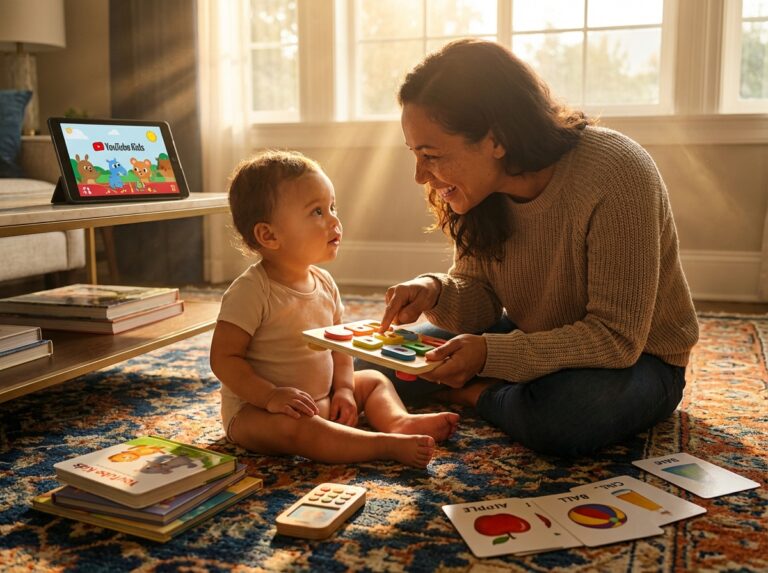
Research increasingly links high toddler screen time with slower early language growth. This article examines the latest evidence on screen exposure and speech delay and gives U.S.-focused, expert-backed strategies parents can use at home: play-based language boosts, vocabulary-building activities, milestone monitoring, and easy routines to replace screens and support speech development. Practical tips, evidence summaries, and when to seek help are included.
The Research: Is There a Link Between Screen Time and Speech Delay?
When you search online for an answer to the question, “does screen time cause speech delay?” you’ll find a lot of strong opinions. But what does the actual research say? The simplest answer is that while studies can’t prove direct causation, a large and growing body of evidence shows a consistent *association*—meaning the two factors are observed together, even if one doesn’t definitively cause the other. When the same association appears in multiple high-quality studies, it’s a strong signal for parents and pediatricians to pay attention.
The most significant screen time speech delay research points to a clear pattern. A landmark 2017 study published in JAMA Pediatrics found that for each additional 30 minutes of daily handheld screen time in 18-month-olds, there was a 49% increased risk of expressive speech delay. A more recent and larger study, also in JAMA Pediatrics from 2023, followed over 7,000 children and found what scientists call a “dose-response” relationship. The more screen time a child had at age one, the higher their risk was for delays in communication and problem-solving skills at ages two and four. Specifically, children with one to two hours of screen time per day at age one had a 61% higher chance of communication delays at age two.
Why Is There a Link? The Opportunity Cost of Screens
Researchers believe the link isn’t necessarily about the screen itself being inherently harmful, but about what it displaces. Language learning is not a passive activity. It’s built through thousands of back-and-forth interactions with caring adults. This is often called “serve and return.” A toddler babbles or points, and a parent responds by naming the object or asking a question. This rich, responsive exchange is the primary engine of language development.
When a toddler is watching a screen, these crucial interactions are often lost.
- Reduced Parent-Child Talk. Studies show that when a screen is on, parents and children talk to each other less. Even background TV, which a child isn’t actively watching, has been shown to decrease the number of words a child hears and the number of conversational turns they take with their caregiver.
- Lower Quality Interactions. The interactions that do happen can be of lower quality. A distracted parent looking at their own phone is less likely to engage in the detailed, responsive conversation that builds vocabulary and grammar.
- Displacement of Play and Reading. Screen time often takes the place of activities that are known to boost language, like hands-on play, which encourages problem-solving and communication, and shared book reading, one of the most powerful vocabulary builders.
Some experts also suggest that the fast-paced, stimulating nature of many shows and apps can overwhelm a toddler’s developing attention systems, potentially making it harder for them to focus on the slower, more nuanced pace of human speech.
Important Nuances in the Research
The relationship between screens and speech is complex, and it’s important to understand the limitations of the research.
Content and Context Matter.
Not all screen time is the same. There is a huge difference between a toddler passively watching a fast-paced cartoon alone and video-chatting with a grandparent. The American Academy of Pediatrics (AAP) notes that live video chat is an exception to the no-screen rule for children under 18 months because it is interactive and relational. Similarly, watching a high-quality educational program with a parent who actively discusses the content can be a learning experience. This is called “joint media engagement.”
Confounding Factors.
Researchers work hard to account for other factors that could explain the link between screens and speech delay. These include socioeconomic status, parental education level, and the home literacy environment. It’s also possible that “reverse causation” is at play. In some cases, children who already have language or behavioral challenges may be given more screen time by caregivers who are looking for a way to manage a difficult situation.
What the Experts Recommend
Based on the weight of the evidence, major health organizations have established clear guidelines to protect early language development.
- The American Academy of Pediatrics (AAP) and the World Health Organization (WHO) recommend no screen time for children younger than 18 months, except for video-chatting. For toddlers 18 to 24 months, they advise limiting screens to only high-quality programming that is viewed with a parent. For children ages 2 to 5, the recommendation is to limit screen use to one hour per day of high-quality programs.
- The American Speech-Language-Hearing Association (ASHA) emphasizes that excessive screen time can negatively impact a child’s opportunity to develop language and recommends prioritizing face-to-face interaction.
The takeaway for parents is not that screens are toxic, but that they are a poor substitute for the real-world interaction that fuels a child’s brain. The research strongly suggests that limiting passive screen time, especially before age two, and prioritizing conversation, play, and reading are the best ways to build a strong foundation for communication.
How Different Screen Experiences Affect Language Learning
Not all screen time is created equal. When we talk about screens and language, the conversation often gets simplified to “how much” time a toddler is spending in front of a device. But the research is much more nuanced. The type of screen experience and how a child engages with it matter just as much, if not more, than the raw number of minutes. Understanding these differences is the first step toward building a healthy media plan for your family.
Let’s break down the most common types of screen exposure for toddlers and what the science says about each.
Background Television
This is when the TV is on in the room, but no one is actively watching it. It might seem harmless, but studies consistently show it’s a language learning thief. When a TV is audible, it reduces both the quantity and quality of talk between parents and toddlers. Adults speak less, use fewer complex words, and engage in fewer back-and-forth conversational turns. For a toddler learning to talk, these rich interactions are their primary source of language. The constant noise can also make it harder for them to tune into your voice and learn from the real-world conversations happening around them.
Best Practice: The simplest rule is the most effective. When no one is actively watching, turn the TV off. Create a quieter home environment where your toddler’s babbles and your voice are the main soundtrack.
Passive Viewing (Traditional TV and Videos)
This is what most people picture when they think of “screen time”. It involves a child watching a pre-recorded show or video with no way to interact with the content. For children under two, the brain isn’t yet equipped to translate the 2D images and sounds on a screen into real-world knowledge. This is known as the “video deficit.” A toddler can watch a video of someone building a block tower dozens of time but will learn to do it much faster by watching a real person do it once. Research links high exposure to passive viewing with expressive language delays. A landmark 2017 study found that for every additional 30 minutes of handheld screen time in 18-month-olds, there was a 49% increased risk of expressive speech delay.
Best Practice: Following American Academy of Pediatrics (AAP) and World Health Organization (WHO) guidance is key. Avoid this type of screen use for children under 18-24 months. For toddlers aged 2 to 5, limit it to no more than one hour per day of high-quality programming.
“Educational” Programs and Interactive Apps
This category is tricky because the word “educational” can be misleading. While some high-quality programs designed by developmental experts can introduce new vocabulary, the learning benefits are almost entirely dependent on adult involvement. The same goes for interactive apps. Tapping and swiping might seem engaging, but it’s not the same as the social interaction needed for language learning. The pros and cons of educational apps for toddlers really hinge on one factor: you. Without a parent guiding the experience, an app is just a digital toy. With a parent, it can become a launchpad for conversation.
This is where joint media engagement comes in. It means using media with your child, not as a substitute for your attention. You become the bridge between the screen and their world.
- Label everything: “That’s a blue car! Vroom, vroom!”
- Ask questions: “Where is the monkey going? What do you think he will eat?”
- Connect to their life: “Look, she’s eating an apple. We have apples in our kitchen!”
Here’s a sample script for turning an app into a learning moment:
An app shows a picture of a cat.
You: “Wow, look at that! What is it?”
Toddler: “Cat!”
You: “That’s right, it’s a fluffy orange cat. Just like Grandma’s cat, Tiger! What does the cat say?”
Toddler: “Meow!”
You: “Yes! The cat says meow. Let’s pet the kitty on the screen. So soft!” (You pretend to pet the screen). “Your turn!”
Video Chat
Video chatting is the one screen experience that gets a green light from experts, even for babies under 18 months. Why? Because it’s not passive. It’s a live, responsive, and social interaction. When a toddler babbles at Grandma on the screen and she babbles back in real-time, that’s a conversational turn. This “contingent interaction” mimics in-person conversation, which is the foundation of language learning. So, is video chat for toddlers OK? Yes, it can be a wonderful tool for connecting with loved ones and supporting social-emotional bonds when a caregiver is there to help facilitate.
Best Practice: Treat video calls like a visit. Stay with your toddler, help them engage, and point out who is on the screen. It’s about connection, not content.
Screen Smart Daily Routines and Play-Based Language Boosters
Transforming your daily life from screen-centric to conversation-rich doesn’t require a complete overhaul. It’s about finding small, powerful moments to connect and build language. The goal is to replace passive screen time with active, engaging interactions that fuel your toddler’s communication skills. This happens through predictable routines and playful learning woven into the fabric of your day.
A structured daily routine helps toddlers feel secure and reduces the friction that often leads to reaching for a screen. It creates natural pockets of time for connection. Here is a sample schedule for a toddler around 18-30 months old that balances their needs for play, rest, and learning.
A Sample Screen-Smart Toddler Schedule
- 7:00 AM Wake Up & Cuddle Time. Start the day with a song or simply talking about what you’ll do. “Good morning, sunshine! Let’s get a clean diaper and then have some yummy breakfast.”
- 7:30 AM Breakfast. Narrate the meal. “You’re eating oatmeal with big, red strawberries. Is it warm?”
- 8:30 AM Independent Play. Set out a sensory bin or building blocks while you clean up. Stay nearby and comment on their play occasionally.
- 9:30 AM Caregiver-Led Language Activity. This is your dedicated 15-20 minutes. Choose an activity from the list below, like reading books or playing with puppets.
- 10:00 AM Outing or Active Play. A trip to the park, the grocery store, or just playing chase in the backyard. Narrate what you see.
- 11:30 AM Lunch.
- 12:30 PM Naptime Routine. A quiet story or lullaby helps wind down.
- 1:00 PM Nap.
- 3:00 PM Wake Up & Snack.
- 3:30 PM Purposeful Screen Time (Optional, 15-20 minutes). If you use screens, this is the time. Sit together and co-view a high-quality educational program. Use it as a conversation starter. “Look, the cat is climbing the tree! What sound does a cat make?”
- 4:00 PM Free Play & Chores. Involve your toddler in simple tasks like putting toys in a basket or “helping” you fold laundry. Talk about what you’re doing.
- 5:30 PM Dinner.
- 6:30 PM Bath Time. A perfect time for language games, songs, and sensory play with water.
- 7:00 PM Bedtime Routine. Read a few favorite books, sing songs, and talk about the day.
- 7:30 PM Bedtime.
12 Play Ideas to Boost Toddler Speech
These low-prep activities are designed to build vocabulary, conversational skills, and social understanding. Aim for just 15-20 minutes of focused, playful interaction a day.
- Pretend Play Scripts.
Act out simple routines with dolls or stuffed animals. Feed the bear, put the dolly to bed, or have the toy animals talk to each other. This teaches verbs, sequencing, and social scripts. - Object Play with Real Items.
Use a basket of safe household objects (a wooden spoon, a soft brush, a clean sock) and talk about them. “This is a spoon. We stir with a spoon. It feels smooth.” - “I Spy” with Objects.
Instead of colors, use functions or descriptions. “I spy something we sit on.” (Chair). “I spy something you wear on your feet.” (Shoes). - Descriptive Bag.
Put a few familiar toys in a cloth bag. Have your toddler reach in without looking and describe what they feel. “It’s hard and round. It’s a ball!” - Sensory Bins.
Fill a small bin with dry pasta, rice, or water and add scoops and cups. It’s a fantastic way to introduce action words (scoop, pour, dig, splash) and descriptive words (wet, cold, bumpy). - Sing Songs with Actions.
Songs like “The Wheels on the Bus” or “Head, Shoulders, Knees, and Toes” connect words with movements, which helps with memory and comprehension. - Puppet Play.
You don’t need fancy puppets; a sock or even your hand will do. Puppets can make it less intimidating for a hesitant talker to engage in a back-and-forth “conversation.” - Photo Album Tour.
Look at pictures of family members and friends. Name the people and talk about what was happening in the photo. “There’s Grandma! We were eating cake at your birthday party.” - Building Block Narration.
Build a tower together and narrate the process. Use words like up, on top, more, big, and crash! This teaches prepositions and concepts. - Read the Same Book Repeatedly.
Repetition is key for learning. Pause before a familiar word and let your toddler fill in the blank. “The little mouse saw a big, red…” (strawberry). - Go on a “Listening Walk.”
Walk around your home or yard and listen for sounds. A dog barking, a car driving by, a bird chirping. Label each sound you hear. - Fort Building.
Drape a blanket over two chairs and create a cozy fort. This simple act involves teamwork and words like in, out, under, and over.
10 Quick Vocabulary Boosters for Everyday Moments
You don’t need special toys or dedicated time to be a language booster. Weave these techniques into your daily interactions.
- Narrate Everything.
Talk about what you’re doing, seeing, and hearing during routines. At the grocery store: “Let’s get some yellow bananas. They go in the cart.” - Expand on Their Words.
When your toddler says a word, repeat it back and add one or two more words. If they say, “Truck,” you say, “Yes, a big, blue truck!” - Recast Their Phrases.
Gently correct their grammar by modeling the correct form. If they say, “Her go,” you can respond, “Yes, she is going to the park.” - Embed Choices.
Offer choices throughout the day to expose them to more vocabulary. “Do you want to wear the striped shirt or the spotty shirt?” - Use Rich Adjectives and Verbs.
Instead of just “The dog is big,” try “The dog is enormous and fluffy.” Instead of “The car goes,” try “The car is zooming!” - Label Emotions.
Help them build emotional vocabulary. “You’re smiling! You feel so happy.” or “You fell down. That looks like it hurt. You feel sad.” - Ask Open-Ended Questions.
Instead of questions with a “yes” or “no” answer, try questions that start with “What,” “Where,” or “Who.” Even if they can’t answer fully, it encourages thinking. - Be a Sportscaster.
Comment on what your child is doing. “You are stacking the blocks. You put the red one on top. Wow, what a tall tower!” - Pause and Wait.
When you ask a question or sing a familiar song, pause for a few seconds to give them a chance to respond. This teaches the rhythm of conversation. - Connect to Their World.
If you read a book about a cat, point out a real cat later in the day. “Look! Just like the cat in our book!”
Making It Work for Your Family
For Busy Parents:
Focus on “routine talk.” The most powerful language moments happen during diaper changes, meals, and bath time. You don’t need to add anything new, just infuse language into what you’re already doing.
Involving Siblings and Caregivers:
Encourage older siblings to “read” picture books to the toddler or play simple games. Share this list of strategies with grandparents or other caregivers so everyone is on the same page.
For Bilingual Households:
Use these strategies in all languages spoken at home! Exposing your child to multiple languages is a gift. It is normal for bilingual children to mix words from different languages; this is a sign of their developing brain, not confusion.
Setting Screen Time Rules That Stick
Creating a healthy media environment is about consistency, not perfection. If you’re feeling overwhelmed by your own screen use, try putting your phone in another room during playtime or meals to be more present.
- Use a Visual Timer.
A sand timer or a color-coded timer helps make an abstract concept (“five more minutes”) concrete for a toddler. When the timer goes off, screen time is over. No negotiation. - Create “Tech-Free” Zones and Times.
The dinner table and bedrooms are great places to start. This helps everyone in the family disconnect and reconnect with each other. - Talk About the “Off” Switch.
When it’s time to turn off the device, make it a clear routine. Say, “All done! Time to say bye-bye to the screen.” and immediately transition to a fun, preferred activity, like a snack or a favorite game. - Consider a Reward Chart for Cooperation.
For older toddlers (closer to 3), a simple sticker chart for turning off the screen without a tantrum can be effective. Focus on praising the positive behavior.
By building these small habits into your day, you create a language-rich environment where your toddler can thrive, turning everyday moments into building blocks for communication.
Monitoring Progress and Getting Professional Support
You are your child’s first and best teacher, and you are also their most important observer. After incorporating more interactive play and conversation into your daily routines, you may start wondering, “Is it working? How do I know if my toddler is on track?” Monitoring your child’s progress is a natural and important part of this journey. It’s not about creating pressure; it’s about being an informed and proactive parent. A simple way to start is by keeping a communication log in a notebook or a note on your phone. Jot down new words, gestures, or sounds you hear. Note when your child initiates a “conversation” or follows a simple direction. This isn’t for grading them, but for spotting patterns and celebrating small victories. For a more structured approach, the CDC’s “Learn the Signs. Act Early.” program offers free, easy-to-use milestone checklists and a mobile app that can help you track development from month to month.
At your toddler’s well-child visits, your pediatrician is also monitoring development. They use standardized screening tools to get a quick snapshot of your child’s skills. One of the most common is the Ages & Stages Questionnaires (ASQ), a parent-completed checklist that covers communication, motor skills, and problem-solving. At the 18- and 24-month checkups, your doctor will also likely use the Modified Checklist for Autism in Toddlers (M-CHAT) to screen for early signs of autism spectrum disorder. It’s important to remember that these are screening tools, not diagnostic tests. A flag on a screener simply means that a closer look by a specialist is a good idea.
Some communication patterns are considered “red flags” that warrant a prompt conversation with your pediatrician, regardless of what a general milestone chart says. These include:
- Little or no babbling by 9 months.
- Not responding to their name by 12 months.
- Not using gestures like pointing or waving by 12 months.
- No single words by 16 months.
- Fewer than 50 words and no two-word phrases (like “more milk”) by 24 months.
- Any loss of speech, babbling, or social skills at any age.
If you notice any of these, it’s time to act. Trust your gut. You know your child best.
When you bring up your concerns, be specific. Instead of saying, “I’m worried about his speech,” try, “I’ve been keeping a log, and at 20 months, he has about ten words and isn’t putting any together. The CDC checklist suggests he should have more. I would like a referral for a speech and language evaluation.” Bring your communication log and a filled-out milestone checklist to the appointment. This documentation helps your pediatrician understand your concerns and justifies a referral. In the United States, there are two primary pathways for getting help. For children from birth to age three, services are provided through the federal Early Intervention program (often called Part C), which is run by each state. You can ask your pediatrician for a referral, or you can refer your child yourself. A simple online search for “[Your State] Early Intervention Program” will lead you to your state’s portal. For children over age three, services are typically provided through the local public school system.
Once a referral is made to Early Intervention, a service coordinator will contact you to schedule an evaluation, which must happen within a specific timeframe (often 45 days) by law. The evaluation is usually done by a team that may include a speech-language pathologist (SLP), an occupational therapist, and a developmental specialist. Don’t picture a sterile, clinical test. For a toddler, a good evaluation looks a lot like structured play. The SLP will use toys, books, and games to observe how your child understands language (receptive skills), how they express themselves (expressive skills), their play skills, and their social interaction. A big part of the evaluation is talking to you. You’ll be asked about your child’s communication history, their strengths, and your family’s priorities.
If the evaluation shows that your child is eligible for services, the team will develop an Individualized Family Service Plan (IFSP) with you. Therapy for toddlers is almost always play-based. The SLP might build block towers to work on concepts like “up” and “down,” have a tea party to practice requesting and social turn-taking, or use bubbles to encourage new sounds and words. Another highly effective approach is parent coaching, where the SLP teaches you specific strategies to use during your everyday routines. This empowers you to be your child’s primary therapist, integrating language-boosting moments throughout the day. Many providers now offer teletherapy, which can be just as effective as in-person services, especially for parent coaching models. It offers flexibility and allows the therapist to see your child in their natural environment.
Navigating the cost of services can be daunting, but there are options. Early Intervention services are funded by federal and state governments and are often provided at no cost or on a sliding scale, regardless of your income or insurance status. If you have private health insurance, it may cover speech therapy, but you’ll want to check your plan for details on co-pays, deductibles, and whether you need pre-authorization. Medicaid is also a crucial resource for eligible families. For families who don’t qualify for EI or want to supplement services, paying privately is another option.
For bilingual or multilingual families, it is critical to find a provider who practices cultural sensitivity. Raising a child with more than one language is a strength and does not cause speech delays. A proper evaluation must consider all of the child’s languages. If a bilingual SLP is not available, ask for an interpreter to be present. Your child’s total vocabulary across all languages is the best measure of their skills.
To find help, start with a search for your state’s Early Intervention portal. You can also use the American Speech-Language-Hearing Association (ASHA) ProFind tool to locate certified SLPs in your area. The CDC and the American Academy of Pediatrics (AAP) websites are also treasure troves of reliable information on child development. Taking that first step to ask for help can feel overwhelming, but it is the most powerful and loving thing you can do to support your child’s communication journey.
Common Questions Parents Ask
Navigating the world of parenting advice can be overwhelming, especially when it comes to screens. This list of frequently asked questions is designed to give you clear, research-backed answers to your most pressing concerns. While these tips can help, always trust your instincts. If your child loses previously acquired skills or you have a persistent gut feeling that something is wrong, contact your pediatrician immediately rather than waiting.
1. What are the official AAP screen time recommendations for toddlers?
The American Academy of Pediatrics (AAP) advises no screen time for children under 18 months, with the exception of live video chat. For toddlers 18 to 24 months, the AAP suggests introducing high-quality digital media only if you watch it with them to help them understand what they’re seeing. For children ages 2 to 5, limit screen use to just 1 hour per day of high-quality programming. The key is always co-viewing and interacting with your child about the content.
2. Are “educational” TV shows and apps actually helpful for speech?
While some high-quality programs are designed to teach vocabulary, research consistently shows they are most effective when a parent watches along, repeats words, and connects the content to the child’s world. This is called “joint media engagement.” Passive viewing alone, even of educational content, is linked to poorer language outcomes. A 2023 JAMA Pediatrics study found that more screen time at age 1 was associated with communication delays at ages 2 and 4, regardless of content.
3. Is it okay for my toddler to video chat with grandparents?
Yes. The AAP makes a specific exception for video chatting because it’s not passive screen time. When a toddler interacts with a responsive person on a screen in real-time, it mimics a live conversation. This back-and-forth interaction, or “serve and return,” is the foundation of language learning. So, those calls with family are a great way to build connection and practice communication skills, as long as a caregiver is present to help facilitate.
4. Does having the TV on in the background harm my toddler’s language?
Even if no one is watching, background TV can disrupt language development. Studies show that when a television is audible, both parents and children talk less, and the quality of their interactions decreases. Those little conversations throughout the day are critical for building vocabulary and grammar. Turning off the background noise is one of the simplest and most effective ways to create a richer language environment for your toddler.
5. I’m worried my child’s screen time could cause autism. Is there a link?
There is no scientific evidence that screen time causes autism. Autism Spectrum Disorder (ASD) is a complex neurodevelopmental condition with genetic and biological origins. While excessive screen use and ASD can sometimes share overlapping signs, such as delayed speech or reduced social interaction, one does not cause the other. If you have concerns about autism, it is essential to speak with your pediatrician about a developmental screening.
6. We are a bilingual family. Should we avoid screens completely?
Bilingualism does not cause speech delay. In fact, learning multiple languages has many cognitive benefits. The screen time guidelines are the same for bilingual children. The most important factor for language development in any language is hearing it spoken by caring, responsive people. Prioritize face-to-face conversations, reading, and playing in both languages. If you use screens, try to find high-quality content in your target languages and co-view with your child.
7. How do I set screen time rules without causing constant tantrums?
Consistency and predictability are your best friends. Create a simple media plan where screen time happens at the same time each day, so it doesn’t feel random. Use a visual timer to signal when screen time is about to end. Give verbal warnings like, “Five more minutes, then it’s time to build with blocks!” Most importantly, have an engaging, non-screen activity ready to transition to. This shifts the focus from what’s ending to the fun that’s about to begin.
8. My toddler already watches a lot of screens. Where should I start cutting back?
Start small to avoid feeling overwhelmed. The easiest first step is turning off background TV. Next, try a “screen swap.” Identify one 30-minute period of screen time and replace it with 15 minutes of focused, one-on-one time. You could read a couple of books, sing songs, or do a simple puzzle together. The goal isn’t perfection but gradual progress. A 2017 study found each additional 30 minutes of daily handheld screen time was linked to a 49% increased risk of expressive speech delay, so every reduction helps.
9. Are interactive apps better for my toddler than just watching videos?
Interactive apps can be slightly better than passive videos, but only if a parent is playing along. An app becomes a language-building tool when you use it to talk with your child, asking questions like, “What color is that apple?” or “Let’s find the cow!” However, research shows that when toddlers use apps by themselves, the language learning benefits are minimal. The app can’t replace the rich, responsive feedback that you provide.
10. When should I be seriously concerned about my toddler’s speech?
While every child develops at their own pace, there are some key milestones to watch for. You should talk to your pediatrician if your toddler isn’t using any single words by 15-18 months, has a vocabulary of fewer than 50 words by age 2, or isn’t combining two words together by 24 months (e.g., “more milk”). A loss of any previously acquired speech or social skills is also a red flag that requires immediate attention. Trust your gut; you know your child best.
Final Takeaways and A Simple Action Plan
Navigating the world of toddlers and technology can feel overwhelming, but the research offers a clear and hopeful path forward. The key takeaway isn’t that screens are inherently bad, but that they often take the place of the rich, back-and-forth interactions that are the primary fuel for language development. Every moment a toddler spends passively watching a screen is a moment they are not babbling with you, listening to your voice, or practicing the conversational turns that build their brain. The goal is not total screen elimination, but a thoughtful balance that prioritizes human connection. It’s about making screen time more intentional and interactive when it does happen, and reclaiming those precious minutes for connection wherever you can.
Here is a simple, 7-step action plan you can start this week to create a more language-rich environment for your toddler.
- Turn Off the Background Noise.
For one week, make a conscious effort to turn off the TV or any streaming device when no one is actively watching. Why it matters: Research shows that even background TV reduces the number of words adults speak and the quality of parent-child interactions. Replacing that noise with quiet creates space for spontaneous chatter. - Establish Two “Sacred” Screen-Free Zones.
Designate the dinner table and your toddler’s bedroom as 100% screen-free areas. Why it matters: Mealtimes are prime opportunities for conversation, and keeping screens out of the bedroom is linked to better sleep, which is critical for learning and development. - Try the “15-Minute Floor Time” Swap.
Three times a day, trade 15 minutes of potential screen time (yours or theirs) for 15 minutes of dedicated, face-to-face floor play. Build with blocks, roll a ball, or make funny faces. Why it matters: This directly replaces a passive activity with the active “serve and return” interactions that are proven to boost language skills. - Shift from Supervisor to Co-Viewer.
When your toddler does watch a program, sit with them for at least five minutes. Talk about what’s happening on screen. “Look, the bear is climbing a tree! What color is the bear?” Why it matters: This practice, called joint media engagement, transforms a passive experience into an active language lesson, helping your child connect what they see to words. - Narrate One Daily Routine.
Pick one routine, like changing a diaper or getting dressed, and become a sportscaster. Describe everything you’re doing in simple terms. “Okay, let’s put on your red shirt. One arm in… now the other arm!” Why it matters: This is an effortless way to immerse your toddler in a constant stream of relevant vocabulary and sentence structure. - Do a Milestone Check-up.
Use a reliable tool to see how your child’s skills compare to typical developmental milestones. Why it matters: Knowledge is power. Understanding what’s expected at your child’s age helps you know when to relax and when to act. The CDC’s “Learn the Signs. Act Early.” program has free, easy-to-use milestone checklists. - Schedule a “Worry Window” with Your Pediatrician.
If the milestone check raises concerns, or if your parental intuition just won’t quiet down, call your pediatrician’s office and schedule an appointment specifically to discuss your child’s speech development. Why it matters: Early intervention is the single most effective tool for supporting children with delays. Don’t wait.
For more detailed information, you can search for resources from the American Academy of Pediatrics (AAP) and the American Speech-Language-Hearing Association (ASHA). To find local support, search online for “[Your State] Early Intervention Program” to learn about free or low-cost developmental evaluations and services.
Your action plan for today is simple. Choose just one of the steps above and commit to it for the next two weeks. Track your progress. Notice the small changes. If your concerns persist after that, you have a clear next step. Trust your gut and talk to your pediatrician. You are your child’s best advocate.
***
Suggested SEO-Friendly Closing Lines:
Discover how to balance screen time and support your toddler’s speech. Our expert guide offers research-backed tips and a simple action plan for parents.
Worried about screen time and speech delay? Get clear answers, milestone guides, and practical play ideas to boost your toddler’s language at home.
***
Suggested Meta Description (158 characters):
Concerned about screen time and speech delay? Our guide explains the research and provides a 7-step plan to boost your toddler’s language with simple, daily habits.
References
- Mobile Media Device Use is Associated with Expressive Language … — Our study demonstrated that in 18-month-old children, an increase in 30 minutes per day in mobile media device use was associated with a 2.3 times increased …
- The impact of passive screen time on early childhood speech and … — This study revealed that excessive and early screen exposure is significantly associated with speech and language delays in children aged 5–8 years. Conversely, …
- Does Screen Time Cause Delayed Development in Toddlers? — Each additional 30 minutes they spent on these devices translated into a 49% increase in the likelihood of delayed speech development.
- The Great Screen Debate: What does research say about screen … — A 2017 study published in JAMA Pediatrics found that increased screen time at 18 months was associated with a delay in expressive language …
- The effects of screen time on children: The latest research parents … — “Studies show that risks for language delay were worse if they started screen time before 12 months of age,” Yang said. Other studies showed …
- Screen Time Exposure at Age 1 Year and Developmental Delay at … — In this study, greater screen time for children aged 1 year was associated with developmental delays in communication and problem-solving at ages 2 and 4 years.
- What Does Too Much Screen Time Do to Children's Brains? — According to data, using a validated screening tool, 1-year-olds who were exposed to more than four hours of screen time per day showed delays …
- [PDF] Does Screen Time Do More Damage in Boys Than Girls? | Cureus — Consistently, research has demonstrated a higher prevalence and greater impact of expressive language delay among boys compared to girls [19].
Legal Disclaimers & Brand Notices
The content provided in this article, including information regarding child development, speech milestones, health recommendations (such as those from the AAP and WHO), and guidance on seeking professional intervention, is for informational purposes only. It is not intended to be a substitute for professional medical advice, diagnosis, or treatment from a qualified pediatrician, speech-language pathologist, or other healthcare provider.
Always seek the advice of your physician or another qualified health provider with any questions you may have regarding a medical condition or developmental concern. Never disregard professional medical advice or delay in seeking it because of something you have read in this article. If you believe your child is experiencing a developmental delay, contact your pediatrician or local Early Intervention program immediately.
All product names, logos, and brands mentioned, including but not limited to the American Academy of Pediatrics (AAP), World Health Organization (WHO), American Speech-Language-Hearing Association (ASHA), Centers for Disease Control and Prevention (CDC), Ages & Stages Questionnaires (ASQ), and Modified Checklist for Autism in Toddlers (M-CHAT), are trademarks or registered trademarks of their respective owners.