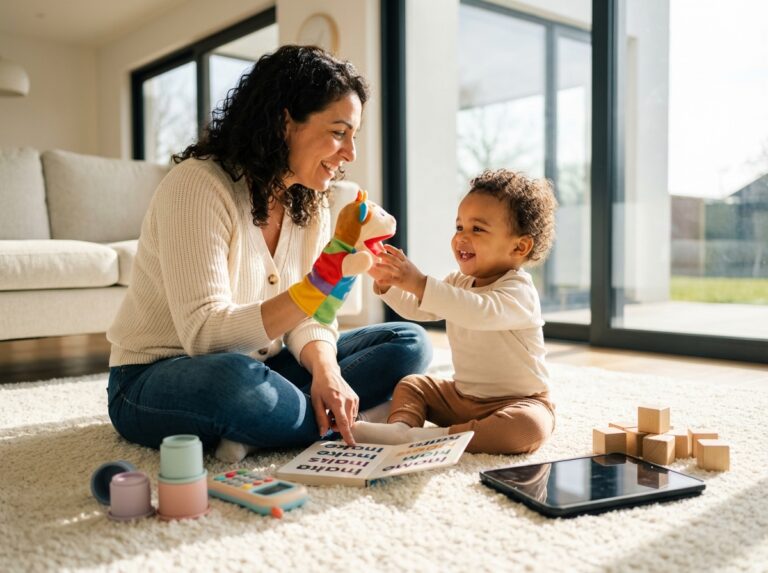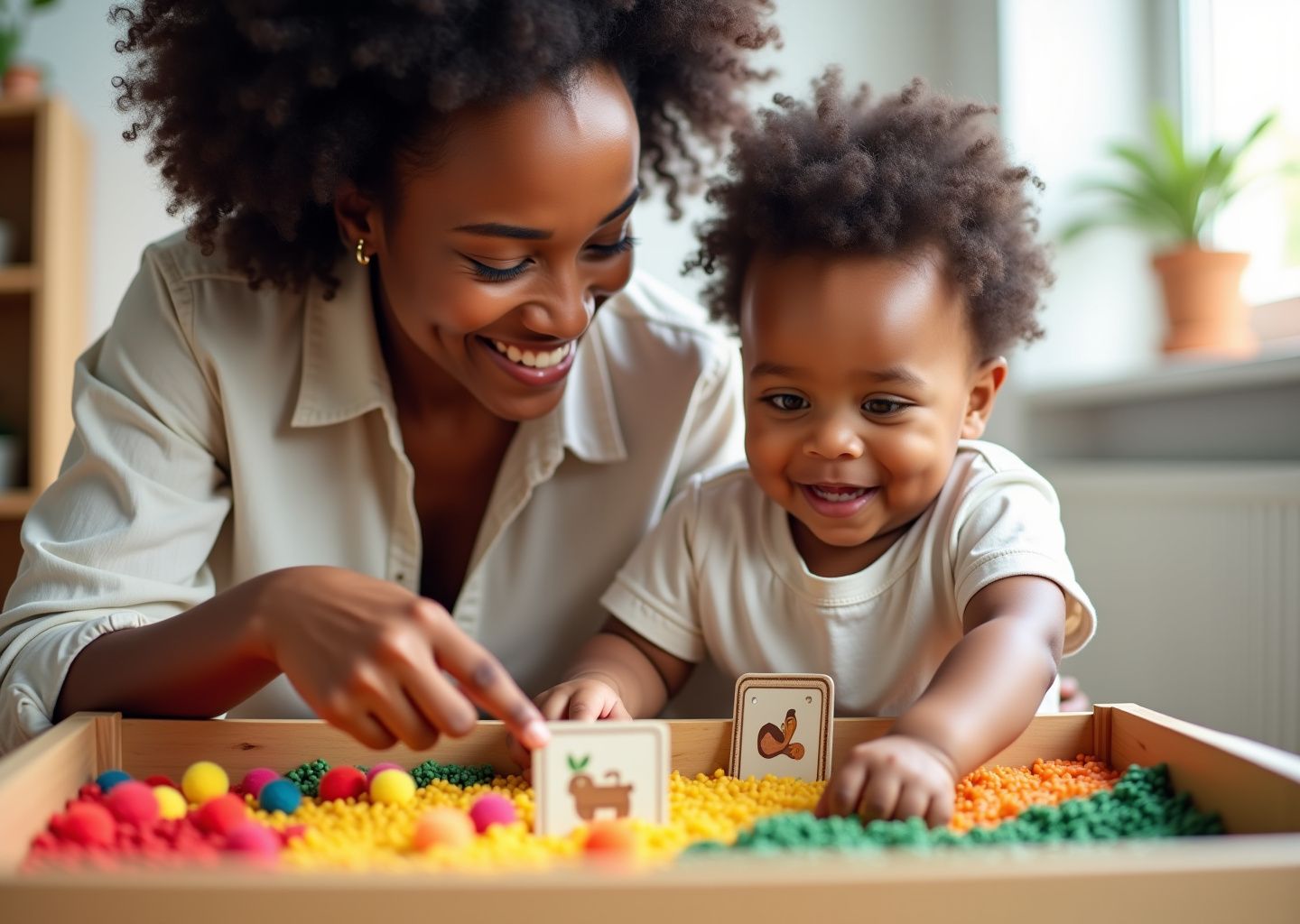
Sensory bins are a playful, low-prep way to boost toddlers’ speech and vocabulary at home. This article explores ten easy sensory bin ideas, practical scaffolding strategies from speech and language experts, milestone-linked targets, safety and cleanup tips, and parent-friendly scripts to turn everyday play into powerful language learning moments.
Why sensory bins help vocabulary growth
You’ve probably heard about sensory bins, but you might wonder if they’re more than just a fun way to make a mess. The answer is a resounding yes. From a speech-language perspective, these simple bins are one of the most powerful tools you can use at home. The magic lies in how they engage multiple senses at once, a concept known as multisensory learning.
When your toddler plunges their hands into a bin of cool, smooth water beads or listens to the rattle of dry rice being poured into a cup, they aren’t just playing. They are building stronger neural pathways for language. Research consistently shows that when children see, hear, and touch something while learning its name, the word sticks. Think about it, learning the word “apple” from a picture is good, but holding a real apple, feeling its weight, and smelling its sweetness creates a much richer, more memorable connection in the brain. Studies confirm that linking words to tactile experiences helps toddlers learn them faster. These *sensory bins* are a perfect, playful way to create these rich learning moments every day.
Sensory bins are amazing language-building tools because they naturally create opportunities to talk about a wide variety of concepts. They go far beyond just naming objects. During a single play session, you can target many different types of words.
- Nouns
These are the easiest to start with. The objects in the bin become your vocabulary list, like spoon, cup, car, or bean. - Verbs
This is where the action is. Your toddler is constantly doing things, giving you chances to model words like pour, scoop, dig, stir, hide, and find. - Adjectives
Sensory play is all about description. You can talk about how things feel, look, and sound. Think of words like wet, dry, soft, bumpy, smooth, big, little, red, or blue. - Spatial Concepts & Prepositions
Where are the objects going? These words are tricky for toddlers, but bins make them concrete. You can model in, out, on, under, next to, and up. - Categories & More
As your child grows, you can use bins to sort by color or type (all the animals go here), practice plurals (one car, two cars), and build early sentences (“big car in“).
Beyond just words, sensory play builds the foundations of conversation. When you and your toddler are both focused on the same bin, you are practicing joint attention. This shared focus is critical for language learning; it’s how your child learns that the word you’re saying connects to the object they’re holding. This shared experience also creates natural opportunities for turn-taking. Simple phrases like “My turn to scoop” and “Your turn to pour” teach the back-and-forth rhythm of a conversation. It’s also the perfect setting to expand on what your child says. If they say, “Car,” you can say, “Yes, a blue car. The blue car is driving!” This modeling helps them move from single words to longer phrases.
*Toddler speech* development happens fast, so you can easily adapt your sensory bins to match your child’s stage.
For Younger Toddlers (12–18 months)
At this age, toddlers are typically moving from babbling to using their first single words. By 18 months, many have a vocabulary of 10-20 words. Your goal is to build their understanding and use of simple nouns and verbs.
- Bin Setup: Use large, taste-safe fillers like big pom-poms, dry pasta, or even just water with large toys. Safety is key, as everything will likely go in their mouth.
- Language Focus: Stick to simple, concrete words. Model nouns like ball and cup and action words like splash and pat.
For Older Toddlers (24–36 months)
By 24 months, toddlers often have 200-300 words and are starting to combine them into two-word phrases. By 36 months, their vocabulary can explode to 1,000 words and simple sentences.
- Bin Setup: You can introduce smaller fillers like rice, beans, or sand (always with close supervision). Add more complex tools like funnels, tongs, and measuring cups.
- Language Focus: Introduce adjectives (bumpy rice), prepositions (put the dinosaur under the leaves), and simple storylines (the animals are eating). You can ask simple “what” and “where” questions to encourage them to talk.
To make these *vocabulary activities* effective without feeling like a chore, here’s a simple framework.
Set Tiny Goals
Don’t try to teach 20 words at once. Choose just 3–4 target words for each play session. Maybe this week’s goal for your farm bin is to model the words cow, eat, and in. That’s it. Keeping it simple makes it successful.
Narrate, Don’t Quiz
Your job is to be the sports announcer for their play. Talk about what you’re doing and what they’re doing. This is a *play-based therapy* technique called parallel talk. Instead of asking, “What’s this?” just model the language. “You’re scooping the rice. Scoop, scoop, scoop. I’m pouring the rice. Pour, pour.”
Notice the Progress
It can be hard to see growth day-to-day. Try a simple tracking method. Keep a sticky note on the fridge and jot down any new words you hear your child use. Or, take a one-minute video of your sensory bin play each week. When you look back after a month, you’ll be amazed at how much their language has grown. This helps you see what’s working and gives you a wonderful keepsake.
Ten easy sensory bin ideas with target words and scripts
Here are ten simple sensory bin ideas to get you started. Each one is designed for easy setup and powerful language learning at home. Remember to choose a few target words for each session and focus on having fun together.
1. Farm Harvest Fun
Materials
A shallow bin, uncooked oats or cornmeal, small plastic farm animals (cow, pig, sheep), a small box for a “barn,” and a few scoops or spoons.
Target Words
Nouns: cow, pig, sheep, barn, animals
Verbs: eat, sleep, open, walk, push
Concepts: in, out, soft
Activities & Scripts
Starter (Modeling): Pick up an animal and label it. “I have the cow. The cow says moo.” Put it in the barn. “Cow in.”
Expand (Adding words): When your toddler says “pig,” you can add on. “Yes, a pink pig! The pig eats the oats. Nom nom.“
Challenge (Asking questions): Encourage problem-solving. “Where is the sheep? Can you put the sheep in the barn?”
Details
Suggested Age: 12–24 months.
Milestone Targets: Using first words, imitating animal sounds, following simple directions.
Learning Goal: Build a core vocabulary of common nouns and simple action words.
Safety & Cleanup: Supervise closely, as small toys can be a choking hazard. Oats are taste-safe if mouthing occurs. Place a sheet underneath for quick cleanup.
Vocabulary Boosters
Sing “Old MacDonald Had a Farm.” Read a farm-themed book like Big Red Barn by Margaret Wise Brown. Use picture cards of the animals to match to the toys.
Extension Idea
The next day, add small blocks to build fences or troughs, introducing words like build, stack, and more.
2. Ocean Rescue
Materials
A bin with a few inches of water (add a drop of blue food coloring if you like), plastic ocean animals, small rocks, and a slotted spoon for “rescuing.”
Target Words
Nouns: fish, whale, water, rocks
Verbs: swim, splash, sink, float, scoop, save
Concepts: wet, blue, under, up
Activities & Scripts
Starter (Parallel Talk): Describe what’s happening as you play. “The fish swims. Splash, splash! The rock sinks down, down, down.”
Expand (Combining words): If your child says “fish,” respond with a short phrase. “Blue fish! The blue fish swims fast.”
Challenge (Giving two-step directions): Ask your child to complete a sequence. “Get the whale and put it under the water.”
Details
Suggested Age: 18–30 months.
Milestone Targets: Combining two words (e.g., “wet fish”), understanding spatial concepts.
Learning Goal: Introduce more verbs and prepositions.
Safety & Cleanup: Water play can get messy, so lay down towels. Never leave a child unattended with water.
Vocabulary Boosters
Sing “Slippery Fish.” Read books about the ocean. Talk about which animals are big and which are small.
Extension Idea
Add soap bubbles to the water to talk about bubbles, pop, and float.
3. Dinosaur Dig
Materials
A bin filled with dry rice, sand, or dirt. Bury small dinosaur toys, plastic bones, and smooth rocks. Add a paintbrush for dusting off discoveries.
Target Words
Nouns: dinosaur, rock, bones, dirt
Verbs: dig, find, hide, brush, roar, stomp
Concepts: big, little, hard, hidden
Activities & Scripts
Starter (Modeling sounds & actions): Dig up a dinosaur. “ROAR! I found a big dinosaur. Stomp, stomp, stomp.”
Expand (Narrating play): Describe your child’s actions. “You are digging. You found a rock! You brush the dirt off.”
Challenge (Using “wh-” questions): Prompt more complex language. “What did you find? Where should we dig next?”
Details
Suggested Age: 24–36 months.
Milestone Targets: Using 3-word phrases, asking and answering questions.
Learning Goal: Encourage action words and descriptive adjectives.
Safety & Cleanup: Keep a small dustpan and brush handy for spills. Ensure all items are large enough to not be choking hazards.
Vocabulary Boosters
Read a book from the “How Do Dinosaurs…” series by Jane Yolen. Use dinosaur flashcards to match the toys you find.
Extension Idea
Create fossil imprints by pressing the dinosaurs into playdough.
4. Construction Zone
Materials
Dried black beans, split peas, or lentils as “gravel.” Add small dump trucks, bulldozers, and scoops.
Target Words
Nouns: truck, beans, road, rocks
Verbs: scoop, pour, dump, push, drive, fix
Concepts: full, empty, heavy, go, stop
Activities & Scripts
Starter (Labeling actions): As you play, say what you’re doing. “Scoop the beans. Pour in the truck. Dump it out.”
Expand (Adding concepts): When your child fills a truck, describe it. “The truck is full! Now it’s heavy. Let’s drive.”
Challenge (Encouraging pretend play): Create a scenario. “Oh no, the road is broken! Can you fix it with the bulldozer?”
Details
Suggested Age: 24–36 months.
Milestone Targets: Understanding opposite concepts, using verbs in sentences.
Learning Goal: Build vocabulary around sequences and concepts.
Safety & Cleanup: Dry beans are not taste-safe and can be a choking hazard. This bin is for toddlers who are past the mouthing stage. A vacuum makes cleanup fast.
Vocabulary Boosters
Read Goodnight, Goodnight, Construction Site by Sherri Duskey Rinker. Make truck sounds together (vroom, beep beep).
Extension Idea
Add blocks or magnetic tiles to build structures, introducing words like tall, up, and down.
5. Rainbow Sorting
Materials
A bin filled with large, colorful pom-poms. Add tongs, scoops, and colored bowls or cups for sorting.
Target Words
Nouns: pom-pom, ball, bowl, colors (red, blue, yellow)
Verbs: sort, put, pick up, drop
Concepts: soft, fuzzy, big, little, same, different
Activities & Scripts
Starter (Labeling colors): Hold up a pom-pom. “This is a red ball. It’s so soft.”
Expand (Creating phrases): As your child sorts, comment on their actions. “You put the blue ball in the blue bowl. Good job!”
Challenge (Comparing and contrasting): Ask questions that require thought. “Can you find another soft one? Is this one big or little?”
Details
Suggested Age: 18–30 months.
Milestone Targets: Identifying colors, sorting objects, using adjectives.
Learning Goal: Teach colors, categories, and descriptive words. Multisensory input can make learning abstract concepts like color more concrete.
Safety & Cleanup: Use large pom-poms to avoid choking risks. They are easy to pick up by hand.
Vocabulary Boosters
Read Brown Bear, Brown Bear, What Do You See? by Bill Martin Jr. Sing a song about rainbows.
Extension Idea
Use the tongs to transfer other items, like large blocks or plastic animals, to work on fine motor skills and new nouns.
6. Bug Hunt Adventure
Materials
Green dyed rice or shredded green paper as “grass.” Hide plastic bugs (ladybugs, spiders, butterflies) inside. Provide a magnifying glass and tweezers.
Target Words
Nouns: bug, spider, leaf, grass, bugs (plural)
Verbs: look, find, crawl, fly, hide
Concepts: on, under, next to, creepy
Activities & Scripts
Starter (Modeling discovery): “I’m looking for bugs. I see one! I found a ladybug under the leaf.”
Expand (Describing location): When your child finds a bug, describe where it is. “You found the spider! It’s on the grass.”
Challenge (Prompting searches): Give specific instructions. “Let’s find the bug that can fly. Where is the butterfly hiding?”
Details
Suggested Age: 24–36 months.
Milestone Targets: Using prepositions, understanding plurals, describing locations.
Learning Goal: Focus on spatial words and the concept of plurals.
Safety & Cleanup: Ensure plastic bugs are large enough not to be swallowed. A fitted sheet placed in the bin before filling can be gathered up for instant cleanup.
Vocabulary Boosters
Read The Very Hungry Caterpillar by Eric Carle. Sing “Itsy Bitsy Spider.”
Extension Idea
Take the magnifying glass outside to find real bugs and compare them to the toys.
7. Teddy Bear Picnic
Materials
A base of soft fabric scraps or a small blanket. Add a teddy bear, a doll, toy food, plastic cups, and plates.
Target Words
Nouns: bear, baby, cookie, juice, plate
Verbs: eat, drink, share, want, give, wash
Concepts: hungry, thirsty, yummy, more, all done
Activities & Scripts
Starter (Modeling social routines): “The bear is hungry. Let’s give the bear a cookie. Munch, munch.“
Expand (Using carrier phrases): Model simple sentences for your child to imitate. “I want juice. Do you want juice?”
Challenge (Encouraging turn-taking): Prompt social interaction. “It’s baby’s turn to eat. What does baby want?”
Details
Suggested Age: 18–30 months.
Milestone Targets: Engaging in pretend play, using social words (“please,” “thank you”), making requests.
Learning Goal: Practice conversational turn-taking and social language.
Safety & Cleanup: Ensure all toy food pieces are large. Cleanup is simple—just gather the items.
Vocabulary Boosters
Read The Teddy Bears’ Picnic by Jimmy Kennedy. Sing “Teddy Bear’s Picnic.”
Extension Idea
Add a “washing station” with a small bowl of water and a cloth to wash the dishes, introducing words like wash, clean, and wet.
8. Arctic Adventure
Materials
Cotton balls or sensory foam (shaving cream) as “snow.” Add ice cubes, arctic animal figures (polar bear, penguin), and a blue bowl for “water.”
Target Words
Nouns: snow, ice, bear, penguin, water
Verbs: slide, swim, shiver, hide, melt
Concepts: cold, white, soft, hard, brrr
Activities & Scripts
Starter (Describing sensations): “Feel the snow. It’s soft. Ooh, the ice is cold! Brrr!”
Expand (Combining concepts): “The white polar bear hides in the soft snow. The penguin slides on the cold ice.”
Challenge (Making predictions): Ask “what if” questions. “What will happen to the ice if we leave it here? It will melt!”
Details
Suggested Age: 24–36 months.
Milestone Targets: Understanding descriptive words, learning about cause and effect.
Learning Goal: Focus on adjectives and concepts related to temperature and texture.
Safety & Cleanup: Shaving cream is for external play only; supervise to prevent ingestion. Cotton balls are a cleaner alternative. Have towels ready.
Vocabulary Boosters
Read The Polar Bear and the Snow Cloud by Jane Cabrera. Talk about what clothes we wear when it’s cold.
Extension Idea
Freeze small toys inside ice cubes for your child to “rescue” using warm water, targeting words like stuck, melt, and free.
9. Garden Planting
Materials
A taste-safe “dirt” base (crushed chocolate cookies or crackers). Add small plastic pots, fake flowers, a toy watering can, and a trowel.
Target Words
Nouns: dirt, flower, pot, water, seeds
Verbs: plant, dig, grow, pour, pat
Concepts: in, on top, pretty, all gone
Activities & Scripts
Starter (Modeling a sequence): “First, we dig in the dirt. Then, we plant the flower. Pat, pat, pat.”
Expand (Narrating the process): “You are pouring water on the flower. The flower will grow big and tall.”
Challenge (Recalling steps): Ask your child to remember the sequence. “We planted the flower. What do we need to do next?”
Details
Suggested Age: 24–36 months.
Milestone Targets: Following a 2-3 step direction, understanding sequences, using future tense (“will grow”).
Learning Goal: Teach sequential language and verbs related to processes.
Safety & Cleanup: The taste-safe base is great for kids who still explore with their mouths. A tablecloth underneath helps contain the crumbs.
Vocabulary Boosters
Read The Tiny Seed by Eric Carle. Plant a real seed in a cup and watch it grow over the week.
Extension Idea
Add vegetable toys to the bin to “plant” a vegetable garden, introducing new nouns like carrot, tomato, and pea.
10. Kitchen Creations
Materials
A mix of different uncooked pasta shapes (spirals, shells, tubes). Add bowls, spoons, cups, and small pots.
Target Words
Nouns: pasta, noodles, spoon, bowl, pot
Verbs: stir, cook, mix, eat, serve, pour
Concepts: more, empty, hot (pretend), yummy
Activities & Scripts
Starter (Simple action words): “Let’s cook. Stir the noodles. Stir, stir, stir.”
Expand (Building on pretend play): “The pasta is all done! Let’s pour it in the bowl. Be careful, it’s hot!”
Challenge (Taking orders): Turn it into a game. “I’m hungry. Can I have more noodles, please? What do you want to eat?”
Details
Suggested Age: 18–30 months.
Milestone Targets: Engaging in multi-step pretend play, using plural nouns (“noodles”).
Learning Goal: Promote imaginative play and the use of social and action words.
Safety & Cleanup: Uncooked pasta is hard; supervise to prevent mouthing. Spilled pasta is easy to sweep or vacuum.
Vocabulary Boosters
Read Strega Nona by Tomie dePaola. Pretend to follow a recipe card with pictures.
Extension Idea
Add water to the pasta (in a separate, water-safe bin) to explore how it changes, introducing words like wet, sticky, and soft.
Scaffolding techniques, routines, and progress tracking
You have the sensory bin ready, filled with exciting materials and target vocabulary in mind. Now what? The magic happens in the interaction. It’s not about quizzing your child, but about building a rich language environment where words naturally stick. This is where scaffolding comes in. Think of it as providing just enough support to help your child reach the next step in their language journey, then gradually pulling that support away as they become more confident.
The foundation of scaffolding is a simple prompting hierarchy. You can move through these steps during play, always starting with the least amount of help.
- Modeling and Parallel Talk
This is the simplest and most powerful tool. You are the narrator of the play. Use parallel talk to describe what your child is doing, seeing, and touching. “You’re digging in the sand. You found a shell!” Use self-talk to describe your own actions. “I’m pouring the water. Splash!” This technique can significantly increase a child’s use of verbs. You’re providing a constant stream of language connected directly to their experience, without any pressure for them to respond. - Expansion
Listen to what your child says and add a little more to it. If they hold up a toy and say, “Cow,” you can expand on it by saying, “Yes, a brown cow! The brown cow says moo.” This validates their communication and shows them how to build longer, more descriptive sentences. This technique can noticeably increase a child’s sentence length. - Recasting
This is a gentle way to correct grammar. If your child says, “Me want spoon,” you can recast it by saying, “Oh, you want the spoon? Here is the spoon.” You’re not directly correcting them but modeling the correct grammatical form in a natural, conversational way. - Open-Ended Questions
These are questions that can’t be answered with a simple “yes” or “no.” Instead of asking, “Is the car red?” try asking, “What is the car doing?” or “Where should the car go next?” These questions encourage more complex thought and longer responses, promoting more conversational turn-taking.
A predictable routine helps your child know what to expect and makes sensory bin time a special part of the day. Aim for short, frequent sessions. About 10 to 15 minutes, three to five times a week, is perfect for a toddler’s attention span. Consistency is key. You could try a simple weekly schedule.
Sample Weekly Routine
- Monday, Wednesday, Friday (10 minutes before naptime)
Use the “Farm Bin.” Focus on nouns and animal sounds on Monday (cow, pig, moo). On Wednesday, add verbs (eat, sleep, walk). On Friday, ask simple “what” and “where” questions (“Where is the pig sleeping?“).
To make transitions smoother, use a special song or phrase to signal the start and end of sensory bin time. For cleanup, make it part of the game. “Time to put the animals to bed! Night night, cow.”
To boost learning, add simple visual supports. Laminated picture cards of your target words placed beside the bin can be a great visual cue. Research shows that pairing objects with vocabulary cards can significantly boost noun recall.
For a shy or hesitant toddler, start by playing alongside them without any expectation. Use lots of modeling and parallel talk. Gentle hand-over-hand guidance, like helping them scoop the rice, can build confidence. If your child is easily distracted, keep sessions short (even just five minutes) and use a visual timer so they know when the activity will end.
If your child has a speech delay, slow down your pace and use more repetition. Focus on just one or two target words per session and model them many times. For bilingual families, sensory bins are a fantastic tool. Use target words in both languages. Label the cow as “cow” and “vaca.” This doesn’t confuse children; in fact, it can strengthen their vocabulary in both languages.
Tracking progress doesn’t need to be complicated. Set a small, measurable goal. For example, “My child will use 2-3 new farm animal words spontaneously during play within two weeks.” Keep a simple log in a notebook or on your phone.
- Checklist
List your 5-6 target words for the week. Put a checkmark next to a word each time you hear your child use it correctly. - Anecdotal Notes
Jot down quick notes. “Jan 5 – Said ‘dig fast’ while playing with dinosaurs. First time combining those words!“
If you’re working with a speech-language pathologist (SLP), this data is incredibly valuable. Share your notes and even short video clips of your sensory bin play. Ask your SLP for specific target words or concepts to focus on that align with your child’s therapy goals.
Finally, always prioritize safety and hygiene.
- Materials
Use non-toxic, taste-safe fillers like dry pasta, rice, or oats, especially for children who still mouth objects. If a child puts a non-edible item in their mouth, stay calm and say, “That’s not for eating. Let’s scoop the rice instead,” then gently guide their hand back to a toy. Always check for allergies (e.g., avoid wheat-based items for a child with a gluten sensitivity). - Choking Risks
For children under three, all items in the bin should be larger than the opening of a toilet paper tube. A good guideline is to use items larger than 1.25 inches in diameter and 2.25 inches in length to prevent choking. Constant supervision is essential. - Cleanup
Play on a splash mat or old sheet for quick cleanup. A small dustpan and brush or a handheld vacuum can make tidying fillers like rice a breeze. Wash all plastic toys with soap and water after each session and ensure fillers are completely dry before storing them in an airtight container.
Results and next steps for continued language growth
You’ve explored the “what” and “why” behind sensory bins, and now it’s time to put that knowledge into action. Moving from theory to practice is where the real magic happens. This isn’t about creating elaborate, picture-perfect setups; it’s about creating small, consistent moments of connection that build your toddler’s vocabulary, one word at a time. The power of sensory play lies in its ability to engage multiple senses at once, which research shows helps forge stronger, more durable neural connections for new words.
Think of this as your simple, get-started guide. Don’t try to do everything at once. The goal is progress, not perfection.
- Choose One Starter Bin.
Start with a single, low-prep idea from our list. The farm bin with oats or the ocean bin with water are fantastic first choices. Using just one bin for a week or two allows your child to become familiar with the materials and gives you repeated opportunities to model the same core words. - Pick Three Target Words.
Resist the urge to label everything. For your first bin, select just three functional words. For a farm bin, you might choose cow (noun), eat (verb), and in (preposition). Focusing on a small set of words makes it easier for you to remember to use them and for your toddler to absorb them. - Use Simple Scaffolding Scripts.
You don’t need to be a speech therapist to use professional techniques. Use the strategies discussed earlier: model language by narrating the play, expand on what your child says by adding one or two words, and ask open-ended questions to invite more language. - Keep Sessions Short and Frequent.
A toddler’s attention span is short. Aim for 10 to 15 minutes of focused play, three to five times a week. A short, positive session every other day is far more effective than one long, overwhelming session on the weekend. Consistency is the key. - Track Progress Informally.
You don’t need complicated charts. Keep a note on your phone or a piece of paper on the fridge. Write down your three target words for the week. When you hear your child use one spontaneously, put a checkmark next to it. Seeing this progress is incredibly motivating. - Know When to Consult a Professional.
Sensory bins are a wonderful tool for supporting typical development. However, if you have persistent concerns, it’s always best to speak with a professional. As a general guideline from ASHA, consult your pediatrician or a speech-language pathologist (SLP) if your child is not using at least 50 words by 24 months of age. An evaluation can provide peace of mind and a tailored plan if needed.
As your child’s language grows, you can easily scale the complexity of your sensory bins. Start with concrete nouns (car, ball, spoon). After a few weeks, introduce action words (pour, scoop, hide). From there, you can move on to descriptive words (soft, big, wet) and spatial concepts (in, on, under). The same bin can evolve over months. A simple bin of rice and scoops can first teach “rice” and “scoop,” then “pour” and “dump,” and later “full” and “empty.”
To get even more value, weave sensory bins into your existing routines. Pair your bin with storytime. If you’re reading a book about construction vehicles, create a simple bin with uncooked lentils (“dirt”) and a few toy trucks. Let your child act out the story, digging and pouring as you read. This makes reading an active, multi-sensory experience, boosting comprehension.
Remember, the goal of this playful learning is connection, not perfection. You are giving your child a rich, hands-on way to understand their world and the words we use to describe it. These small, consistent efforts compound over time, building a strong foundation for communication. Every time you scoop, pour, and play alongside them, you are showing them that learning is joyful and that you are their most important teacher.
References
- The relationship between multisensory stimulus-integrated foreign … — This study explores the impact of multisensory stimulus-integrated foreign language learning models on students' psychological states and …
- Touch to learn: Multisensory input supports word … – PubMed Central — Infants experience language in rich multisensory environments. For example, they may first be exposed to the word applesauce while touching, tasting, smelling, …
- The Science Behind Sensory Play: Evidence & Benefits — Research consistently demonstrates that sensory-rich environments literally enhance neural connections, supporting language development, …
- Unlock Literacy and Language Growth with Multi-sensory Learning — Research consistently shows that students learn more effectively when they see it, hear it, touch it, and do it. For Speech-Language …
- Beyond play: a comparative study of multi-sensory and … – Frontiers — This paper explores the efficacy of multi-sensory toys in improving children's attraction, interest, and learning efficiency through a systematic review and a …
- [PDF] Program Evaluation of the Impact of Sensory Room Activities on … — The purpose of this research study is to determine the effect of sensory interventions used in four. Muskegon County Northern Service Unit (NSU) sensory …
- Using Sensory Experiences to Support Elementary Students — Sensory spaces are impactful tools that can be used to help students learn how to recognize, understand, and regulate their feelings at school.
- Investigation of the Relationship Between Sensory Processing Skills … — The study analyzed the data from a language test and sensory processing skills of children using independent t-tests for those with normal …